Light and Color
May 19, 2009
To talk about color divorced from whatever medium in which it is suspended means necessarily taking a theoretical approach. So, a small digression here:
There are many ways in which both the painter and the scientist approach color. For the scientist, a rational model is constructed to categorize and describe it as a phenomena. At colorsystem.com there is an excellent presentation in German of the various scientific theories that have been created over time. Additional to scientific theories, artistic color theories tend to be more relational, more psychological, and ultimately more visceral. The theories of Josef Albers, in ‘The Interaction of Color’ and Johannes Itten, in ‘The Art of Color’ are two such 20th century examples.
Another way to approach color involves viewing it from the standpoint of light itself, that is, additive and subtractive light. Notebook has an interesting resource page on the topic of Light and its qualities. Thus, while the painter’s craft necessarily exists in the world of subtractive light, by manipulating mediums and pigments to experientially stimulate thoughts, emotions and sensations, it derives – as does life itself – from the world of additive light.

additive primaries
The primary colors for additive light are red, green and blue. Thus, if three different spotlights are focused together upon one location, and one light is covered with a filter of red, the second of green and the third blue, the location itself will reveal white light to the human eye. The technologies of television, computer screens and color separation in the printing industry are all based upon additive light theory or RGB (red, green, blue).

subtractive primaries
The primary colors of subtractractive color theory are yellow, red, and blue. Every young child learns this in kindergarden. He/she learns quickly that yellow plus red makes orange, yellow plus blue makes green, red plus blue makes purple, and all three together create black (or a very mucky brown). I call this kindergarden primary color.

process pramaries
A further refinement to subtractive color theory are the primary colors of the printing industry. Rather than the yellow, red and blue of kindergarten, the printing industry uses process yellow, magenta, cyan and black. Process yellow actually contains the slightest bit of green in it – a cool, translucent, lemon yellow. Cyan is a translucent and dark turquoise kind of blue. While magenta is a cool, translucent ruby red, similar to the external fleshy covering of pomegranate seeds. These subtractive primaries, derived from additive light theory combine in different ways – principally through layering – to create the whole gamut of visual color that we experience in 99% of our printed material.
I tend to speculate that if magazine green never comes from green ink, then why should an artist mix his or her colours so easily on the pallette? Similarly, through the luminosity of oil, a painter’s green created from superimposed layers of yellow and blue is qualitatively a different experience than that of a mixed green on the pallette. Thus, since painting occurs in the world of reflective light, and subtractive color combinations are intuitively clear, it’s reasonable to ask, how much palette mixing is truly necessary if the beauty of light itself is the goal? Additionally, any colour we perceive in the natural world is always more beautiful in the degree to which it can transmit light. The ancient techniques for creating imagery are time tested procedures for isolating, cherishing and showcasing the spectral purity and luminosity of individual pigments. The medium of oil is particularly adept at transmitting light through layers.
Medium and Pigments
May 18, 2009
Pigments ground into an appropriate binding medium create paint. The medium defines the paint: the handling (brushwork and siccative qualities), viscosity, translucency, toxicity and permanency. Oil paints are pigments ground and suspended in linseed oil, as acrylics are pigments ground and suspended in acrylic resin. Watercolors are pigments suspended in gum arabic and egg tempera is pigment suspended in the yolk of a fresh egg. Encaustic uses resinated hot wax, while for fresco the setting of the fresh plaster creates the permanency of the water diluted pigment.
Quite naturally, the medium has it’s own qualities which then become a matter of personal taste, capacity or preference. Oil, acrylics and encaustic as mediums, leave a tactile residue of their own quality. Does that quality resonate within you? Find out! All mediums require a support, as for some like watercolor or fresco the support plays a critical, essential role. Do the qualities of the support resonate within you? Find out!
Most modern artists don’t need to grind their own colors to practice their art. However, for the artist working in fresco or egg tempera contact with the powdered pigment is essential. In addition, knowing which pigments to use for which medium is critical not only for successful in-the-moment-handling but also for longevity and personal health. Manuals like ‘Artist’s Handbook of Materials and Techniques’ by Ralph Mayer or Max Doerner’s ‘The Materials of the Artist’ are time honoured general resources. Daniel Thompson’s ‘The Practice of Tempera Painting’ is probably the best comprehensive resource for the tempera painter. Each pigment has its own nuances of hue, saturation and value, also transparency and opacity. Getting to know both mediums and pigments qualitively is a real and exciting adventure. At makingpaint.com you can find extensive information from another working and experimenting artist.
Finally each medium defines its pallette. Fresco due to the chemical interactions of plaster and pigment offers perhaps the most limited choice, while oil may offer the widest. Becoming familiar with pigments and mediums up-close-and-personal is like becoming a master chef. You choose the ingredients based upon experience and a good cookbook, but it’s the attention to detail in the processing that determine a truly successful dish. And who doesn’t enjoy a well prepared meal? Should we treat our eyes with any less care?
Value Study
May 12, 2009

Langerei North value study
I spent years dragging my portable easel out to inspiring locations to paint. Although I managed to create a few interesting paintings, I threw away just as many failures. The changes of season, weather, and light caused any particular landscape to fluctuate enough so that I ended up with mud more often than not. Thus, I had to ask myself, how is it possible to capture anything eternal about what I am viewing?
One solution, I knew, was an impressionistic alla prima technique, and although its effects can be strikingly fresh, for better or worse, my own temperament is drawn to painting in layers, often termed “indirect painting”. Yet attempting to use an indirect technique for sequential forays of painting “en plein air” spelled trouble if I didn’t know fairly precisely where I wanted the painting to go.
Thus, I began to create fairly detailed studies both in watercolor and in pencil in order to understand what I felt and wanted to finally express in paint. Of the two approaches, I felt the (pencil, charcoal or ink) value study to be the most effective for describing my essential reaction to a view. The medium toned paper gives space for imagination to roam, inviting the perceiver in to participate in forms as they arise.
Alternatively, although it is clearly possible to take a photograph in order to capture “a moment” as preparation for a painting, photographs themselves are a mechanistic interpretation of visual reality, inevitably reducing three dimensional space to two. If I want to personally interact with the view before me, to dance with it, to make love to it, to merge with it, then the means needs to be an extension of my fingertips, vibrating with the energetic impulses of my own blood. This is in no way intended as a criticism of the fine art of photography, only a criticism of the use of photography as a means for a study upon which to base a painting.
When I have created a value study that resonates, then I transpose it to a panel and begin preparing for development of the painting.
Gesso
May 9, 2009
Various recipes exist for gesso. Here’s what I use:
The Glue:
Dissolve 2 3/4 ounces of dry rabbit-skin glue with one quart water in a big glass jar (used pickle jars are great for this). This equates to 75 grams dry glue to approximately one liter of distilled water. The proportions work out to approximately 10/1 water to dried glue by volume. Many professional egg tempera painters suggest a higher percentage of 16/1. (I will try this next time around.)
Let it soak overnight.
Heat the glue in a double boiler, that is, with a second pan surrounding the jar with the glue water. The water should be the same temperature as the glue water, so bring the heat up slowly to melt the gelatine glue. Stir gently. The glue should never boil, only melt. Overheating significantly harms the adhesion of the glue, so do not let the temperature rise above 135 F° (57.3 °C), 127F° (53°C) is optimal.
The Filler:
I use calcium carbonate or precipitated chalk or whiting for filler with 10% titanium white or zinc white to insure a bright whiteness to your gesso. The chalk whiting part can vary in both purity and whiteness, depending upon the grade. Industrial grade chalk whiting can be found in most hardware stores or paint shops but I currently buy my calcium carbonate from Kraemer Pigmente. Dry pigments can be found at art supply shops or online suppliers (like Kraemer).
The proportions are 1 lb filler (or 450 grams) to one quart (liter) of glue water. Or 1 1/2 filler to 1 glue water by volume. The chalk is gently poured into the melted glue. I hold a funnel above the glue water, slowly adding the filler. Ideally you should be able to add all the filler in this way until a slight pyramid of filler forms above the fluid surface. Gently stir the mixture, but be careful to avoid creating any air bubbles. They can translate into pinholes in your gesso that are impossible to remove, adversely affecting your pristine starting ground. Lumps can be stirred or strained out (with cheesecloth). The final result should be about the consistency of light cream. Return the mixture to the double boiler (as necessary), keep it warm, but never let it remain too long on the heat as this can adversely affect the integrity of the RS glue.
Applying the Gesso:
Sand the panel lightly to remove any rough texture, clean the dust off with a moist cloth. Cover the board with a light coating of size (1 1/2 oz rabbit skin glue dissolved in one quart water or 45 grams glue to one liter). After the size has dried, begin applying thin coats of gesso. The first coast is loosly brushed or scumbled in. I prefer to apply the gesso to both sides and ends of the panel to avoid any uneven absorption of moisture which might cause warping. I use a wide flat bristle brush (2″), applying thin layers in alternating horizontal and vertical layers. The layers dry quickly, especially in warm weather. Generally a well prepared panel can take about 10 thin coats of Gesso. I wait until 3 or 4 levels have accumulated and begin lightly sanding it down between layers, and then use a moist cloth to remove the dust. For proper adhesion between the layers of gesso it is best to complete your panel in one day’s working session.
Finishing:
After the final coat, the sanding moves from coarse to fine. As a last step, it’s possible to take a slightly damp cloth and rub it gently over the entire surface in circular motions in order to obtain a final smooth, egg shell-like finish. If, however, you intend to use the panel for silver point, it is best to leave that last step out in order to retain a slight tooth to the panel.
The Panel
May 7, 2009
The Panel:
A firm non flexible ground is necessary for painting with egg tempera. On good linen canvas, the oil medium can sustain flexing and shrinking, but egg tempera cannot. If one chooses to work exclusively in oil, canvas may be the ground of choice. As I prefer to use a mixed technique, painting on panel is my preference. Additionally, I find the smoothness of the surface very sensuous.
Of the choices readily and economically available to painters these days, my personal preference is good quality, plywood panels. They are heavier than Masonite but in the long run, more absorbent. They do not warp, and the fine crackles that can occur in the gesso from slight wood expansion can be avoided either by obtaining a high quality piece of plywood from a cabinet maker or by gluing a thin layer of fine linen fabric to the board before the first coat of gesso.
Mixed Technique
May 7, 2009
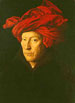
Jan van Eyck mixed technique
The term mixed method or mische technique is generally used to refer to the painting technique of Jan Van Eyck and the Flemish Masters. The mixed part quite literally refers to the method of intermixing the usage of both water based and oil based mediums to create a pictorial image. It requires both patience and sufficient knowledge in order to achieve an attractive result. Traditionally the resulting image was super realistic, but it does not have to be. The main thing is you need to know where you are going. This method allows for the creation of multiple layers of paint which through their superimposition over one another create beautiful effects of both light and color: the essence of abstraction. My own “mische technique” is a bit of a hybrid, using the traditional recipes for sessions of indirect painting and yet allowing each session to be a complete alla-prima painting session.
Nicolas Wacker
The originator of the modern adaptation of the so called mische technique, is a Russian man named Nicholas Wacker, who taught at the Ecole des Beaux Arts, Paris in the early 80’s. I’ve received it from a friend who studied there at that time, thus here below are her class notes:
It is useful for brushability, quickness of drying and glaze layering. Through using this technique one can maximize the use of glaze while simultaneously painting opaque areas into the freshly laid on medium. A fan shaped dry brush can be used to blend and unify the surface. Strong areas can sink into the background while lighter tones can be emphasized. It seems possible that the yolk of an egg could be substituted for the alcasit, though I have never tried it.
Emulsion:
- 1- volume alcasit (methyl cellulose glue)
- 1- volume half of which is pure linseed oil with 1/5 eburit dryer (or sun thickened linseed) and half damar varnish 2:1
- 1- volume water
- Put liquids in a jar in the order written ( alcasit first) and with each addition cover the jar and shake it in well. I heard water could be as much as 3 volumes but never tried it. The result looks like mayonaise. (don’t eat it!)
Medium:
- 1 part damar varnish
- 1 part turpentine
- 1 part stand oil (sun thickened is also fine)
Coat panel or canvas with a light coat of glue size. For canvas, use a recipe for good lean priming (commercial lead white in oil, 1 pound thick paint, diluted with 3 fluid ounces of turpentine). Add at least 3 coats brushed on in opposite directions, lightly sanded in between (if you sand a surface containing any amount of lead white be sure to take precautions. Wear an appropriate mask to avoid inhaling the dust.). For gesso grounds on panels it is best to apply at least 10 thin coats painted in alternating directions, sanding in between coats.
The Design
Find an image from which you wish to work. It can be a reproduction of a painting you admire, or a drawing of your own. You should be able to render it in black and white value studies as well as forsee the addition of color. Transfer the drawing to the primed canvas or prepared panel. Render it in waterproof india ink. Be sure to erase all pencil lines after the drawing is transposed into ink. A final glue size is applied on all surfaces after the preliminary drawing but before the imprimatura.
Paints
It is best to mix fresh white for every session. Use a white powdered pigment (titanium or zinc – but not lead white for toxic reasons) and emulsion. I prefer titanium because of its covering power but it you want a more translucent white then you might choose zinc. Take a glass muller or spatula, pressing, dragging and blending the two together until a consistent texture is achieved. This helps considerably with quick drying. Pour a small amount of emulsion into a small cup or bowl. Use this to increase the brushability of your oil colors. Remember to always honor the fat over lean principle. If you are able grind up your own colors, you will be able to avoid buttery, oily colors from the manufacturer. In additon, you will learn first hand which pigments require more oil to achieve a workable consistency or in contrast which grind up easily and are therefore ‘lean’.
Imprimatura
The white ground is covered with a translucent middle tone. I usually use damar varnish diluted with turpentine 3(T):1(D) mixed with an earth tone (yellow ochre, an umber or a sienna). Using a wide bristle brush apply over the whole panel to achieve a common medium value for the beginning of the image. If you are painting over a traditional gesso ground this priming step is crucial so as to reduce the absorbency of your substrate. If you neglect doing this step you may have trouble with the “sinking in” of your oils later on. If you are painting over an oil primed canvas, just be sure to keep this imprimatura diluted enough to establish a good transparent middle tone. If it is too dilute you may have adhesion issues with the oil ground, if it is too oily, you will have adhesion issues with your successive layers. Time and experience will tell.
Session 1
After this imprimatura is dry, few days should suffice, you can begin to globally establish the values of the painting. Cover the entire painting with a fresh coat of clear medium. Take a clean, dust free cloth and wipe the surface of excess medium. The surface should be tacky and receptive.
Into this slightly tacky surface work in white mixed with emulsion for strong light areas and drag them into the background with a dry brush. This produces a soft way to suggest future values. After that, using a diluted tint of dark pigment (a sienna or an umber) to establish some of the three quarter tones in the shadows. This quickly establishes the values of the painting and you can step back and assess how your idea is working and correct where necessary at an early stage. At this stage it is important to work in passages of opacity, mixing your tones and colors with a bit of white pigment. Let it dry.
Session 2
Repeat the steps as described above. Starting to work in large blocks of color, alternating glaze or emulsion for transparent or opaque effects, respectively. Values can slowly be adjusted. One proceedes from coarse to fine detail. Highlights and shadows can be further refined by moving away from the midtones of the imprimatura while still remaining ‘unfocussed’. Later sessions can define fine highlights and precise shadows. Allow the image to emerge slowly. Don’t fall into the details – yet.
One lovely advantage of the mixed technique is brushability. You can paint one color next to another area of color, then using a dry brush gently blend one area into the other. The colors softly merge without contaminating each other. Good sable brushes are invaluable for manipulating paint; fine bristle brushes can be used for painting larger areas and dry merging. Each painter needs to find his/her own taste. But remember to keep your pigments as pure as possible. Color is color. Mud is mud.
Session 3 or more?
The painting needs to dry thoroughly in between sessions. By using the Mixed Technique and one’s own ground up lean colors, drying time can be greatly reduced. A week is usually enough. In the beginning stage when the painting is less saturated, the drying time might be only a few days. Techniques to insure a lean and thirsty ground are useful. I prefer painting on a firm panel coated with 10 thin coats of traditional chalk gesso. If you do not fully cover this panel with an underpainting of egg tempera, then a coat of size or an imprimatura as described above will be necessary to reduce the absorbency of the gesso. This technique will act differently on canvas, primed with white lead than it will on a panel primed with traditional gesso. The white lead will not be as absorbent.
How many sessions does it take to complete an image? This is best answered by experience. In general, don’t be impatient but also don’t be over generous with your (oily) glazes. Sooner or later there will be a point where the surface cannot receive any more paint. This is not a fast results technique. It can create lovely possibilites for translucent color effects enhanced in layers of glaze, yet contrasted by areas of solid color. Try it out for yourself.

 Atelierartisanal's Blog