The Fresco Pallette
May 19, 2009
Everything changes when you begin to do fresco. The whole process is a chemical reaction in the plaster itself that can take up to 6 months to a year to ‘cure’. So it’s really important to stick with known and trusted colors; the traditional pallette is mainly comprised of earth minerals.
Here is a list:
Browns
Raw umber – Natural earth – Highly Permanent – Tedancy to flour : needs a lot of binder
Burnt umber – Burnt natural earth – Highly Permanent – Mix it well before puddling the colour
Raw Sienna – Natural earth (Italy) – Highly Permanent
Burnt Sienna – Natural earth (Italy) – Highly Permanent – Mix it well with the brush before application
Purples
Cadmium red purple (genuine) – Cadmium sulfo seleniure – Highly Permanent
Reds
Venise red – Iron oxide – Highly Permanent – Very good light resistance – stable in mixture (Mars Red, Pozzuoli Red)
Cadmium red (genuine) – Cadmium sulfo seleniure (minéral) – Highly Permanent – Covering – don’t mix with leads or titanium white
Oranges
Mars orange – Iron oxide – Durable
Yellows
Yellow ochre – Natural earth – Highly Permanent – Many variations and shades of this exist, Italian, Greek, and French
Cadmium yellow (genuine) – Cadmium sulfide – Highly Permanent – Covering – don’t mix with white lead or with ultramarine blue
Greens
Viridian (genuine) – Hydraded chrome oxide – Durable – Very solid in mixture – use it in glazes
Chromium oxide green – Chrome oxide – Highly Permanent – Covering and coloring – very stable in mixture
Green earth (Terre Verde) – Natural earth – Highly Permanent
Blues
Ultramarine blue – Silico-aluminate of polysulfuretted sodiums – Highly Permanent – Luminous and intense – don’t mix with chrome yellow
Cerulean blue (substitute) – Barite sulfate and phtalocianine blue – Highly Permanent – High colouring capacity
Cerulean blue (genuine) – Cobalt stanate – Highly Permanent – Opaque – unvarying in mixture
Cobalt blue – Cobalt aluminate – Highly Permanent – Excellent light resistance – stable in mixture
Black and white
Titanium white – Titanium dioxide – Highly Permanent – Don’t mix with cadmiums – luminous – intense
Lime white – slaked lime – Highly Permanent – dull highlights, natural plaster tint
Lamp black – Carbon – Highly Permanent – the favored black for fresco
This blog space is for those who are actively working with these pigments and who want to exchange information about them. Thus additions and corrections are welcome.
Medium and Pigments
May 18, 2009
Pigments ground into an appropriate binding medium create paint. The medium defines the paint: the handling (brushwork and siccative qualities), viscosity, translucency, toxicity and permanency. Oil paints are pigments ground and suspended in linseed oil, as acrylics are pigments ground and suspended in acrylic resin. Watercolors are pigments suspended in gum arabic and egg tempera is pigment suspended in the yolk of a fresh egg. Encaustic uses resinated hot wax, while for fresco the setting of the fresh plaster creates the permanency of the water diluted pigment.
Quite naturally, the medium has it’s own qualities which then become a matter of personal taste, capacity or preference. Oil, acrylics and encaustic as mediums, leave a tactile residue of their own quality. Does that quality resonate within you? Find out! All mediums require a support, as for some like watercolor or fresco the support plays a critical, essential role. Do the qualities of the support resonate within you? Find out!
Most modern artists don’t need to grind their own colors to practice their art. However, for the artist working in fresco or egg tempera contact with the powdered pigment is essential. In addition, knowing which pigments to use for which medium is critical not only for successful in-the-moment-handling but also for longevity and personal health. Manuals like ‘Artist’s Handbook of Materials and Techniques’ by Ralph Mayer or Max Doerner’s ‘The Materials of the Artist’ are time honoured general resources. Daniel Thompson’s ‘The Practice of Tempera Painting’ is probably the best comprehensive resource for the tempera painter. Each pigment has its own nuances of hue, saturation and value, also transparency and opacity. Getting to know both mediums and pigments qualitively is a real and exciting adventure. At makingpaint.com you can find extensive information from another working and experimenting artist.
Finally each medium defines its pallette. Fresco due to the chemical interactions of plaster and pigment offers perhaps the most limited choice, while oil may offer the widest. Becoming familiar with pigments and mediums up-close-and-personal is like becoming a master chef. You choose the ingredients based upon experience and a good cookbook, but it’s the attention to detail in the processing that determine a truly successful dish. And who doesn’t enjoy a well prepared meal? Should we treat our eyes with any less care?
Silverpoint
May 15, 2009

Hans Holbein silverpoint
Silverpoint is another ancient technique that is receiving renewed attention these days. Jan van Eyck and the Flemish masters are reputed to have regularly used it as a drawing tool. Artists like Picasso and Joseph Stella brought it into the 20th century art world. The final design stands softly but well on its own or can be incorporated as an underdrawing into a painting.
There is an informative site at silverpointweb.com which offers a lot of practical information as well as sales of silver tips and a ground for the drawing support. I bought some of my pure silver tips from him a few years ago. The silver renders a soft, warm gray line that can darken upon exposure to light – just like the silver content of a photograph. The line itself is indelible so it cannot be erased. Another experiential resource is international silverpoint archives.
Drawing with silver is a very simple but time consuming technique. A thin piece of silver is inserted into a drawing stylus instead of a piece of lead. The silver can be obtained from a local silversmith. I have used both pure silver and sterling. The pure silver is reputed to create a slightly darker line, but I have not yet noticed the difference (which could be due to my gessoed surface not having enough tooth, so take my experience with a grain of salt). Points can be chiselled fine or beveled. Darker tones are achieved by repeated gestures and not by an increase in pressure.
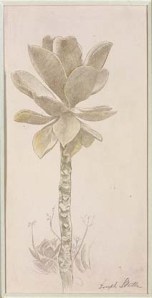
silverpoint Joseph Stella
The drawing surface seems to make a great difference in results. The surface should have a slight “tooth” to it, to draw out the silver particles. I have used both white gessoed panels and toned paper. The toned watercolor paper clearly had the tooth to pull out the silver, but the value of the silver was so close to that of the paper that I finally opted for the white panels. Thus far the panels have given fine results which I have then used as underdrawings for some of my paintings.
Value Study
May 12, 2009

Langerei North value study
I spent years dragging my portable easel out to inspiring locations to paint. Although I managed to create a few interesting paintings, I threw away just as many failures. The changes of season, weather, and light caused any particular landscape to fluctuate enough so that I ended up with mud more often than not. Thus, I had to ask myself, how is it possible to capture anything eternal about what I am viewing?
One solution, I knew, was an impressionistic alla prima technique, and although its effects can be strikingly fresh, for better or worse, my own temperament is drawn to painting in layers, often termed “indirect painting”. Yet attempting to use an indirect technique for sequential forays of painting “en plein air” spelled trouble if I didn’t know fairly precisely where I wanted the painting to go.
Thus, I began to create fairly detailed studies both in watercolor and in pencil in order to understand what I felt and wanted to finally express in paint. Of the two approaches, I felt the (pencil, charcoal or ink) value study to be the most effective for describing my essential reaction to a view. The medium toned paper gives space for imagination to roam, inviting the perceiver in to participate in forms as they arise.
Alternatively, although it is clearly possible to take a photograph in order to capture “a moment” as preparation for a painting, photographs themselves are a mechanistic interpretation of visual reality, inevitably reducing three dimensional space to two. If I want to personally interact with the view before me, to dance with it, to make love to it, to merge with it, then the means needs to be an extension of my fingertips, vibrating with the energetic impulses of my own blood. This is in no way intended as a criticism of the fine art of photography, only a criticism of the use of photography as a means for a study upon which to base a painting.
When I have created a value study that resonates, then I transpose it to a panel and begin preparing for development of the painting.
Egg Tempera Palette
May 9, 2009
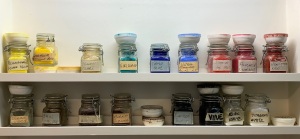
My collection of dry pigments in the studio
The list of pigments available for use in egg tempera is essentially the same as that of oil with the exception of the lead based pigments of naples yellow and flake (lead) white. They are highly poisonous and so should be avoided in powdered form. Additionally, the lead based pigments discolour upon exposure to sulphur fumes. While this discolouration can be avoided by varnishing the final picture why bother when so many other safer pigments are available today?
Powdered pigments can be quite exciting to see and to use – especially for the first time. In egg tempera, you must always work with powders that you grind up into paint for the daily session. I use a glass muller and a piece of frosted glass for this purpose. It is also possible to pre-grind a number of common colors in distilled water and keep this paste in a small airtight jar (with a moistened sponge inserted in the lid) ready for use. This saves working time and energy. This larger work of grinding up pigment pastes then needs doing only once a month or so (depending on your climate and usage). The muller and glass plate need to be thoroughly cleaned after each grinding session.
For daily painting, I usually temper (with egg) only a few pigment pastes for each session. This does not take alot of extra time or effort. A bean of pigment paste mixed up with an equal amount of egg suffices for the paint of the day. A quick test consists of stroke on a piece of smooth glass. When it dries and can be lifted by a one sided razor blade it shows itself to be an internally cohesive ribbon of colour. If it does not form a ribbon and instead dissolves into powder you have not added enough egg yolk.
My palette:
- ultramarine blue (a cool blue)
- thalo blue ( a warm blue. Exceedingly difficult to grind so it requires much patience but since it is such a beautiful colour it’s well worth it)
- cadmium yellow medium (a warm yellow)
- Permanent Lemon Yellow (a cool yellow)
- Cadmium red medium (a warm red)
- Alizarine crimson (a cool red. Another pigment that is difficult to grind but also is well worth it.)
- venetian red (red iron oxide)
- viridian green
- raw umber (fantastic for shadows)
- burnt siena (great for achieving quick grounded warmth)
- yellow ochre
- mars black (carbon black is not good for aqueous solutions)
- zinc white (good for achieving light tints that you wish to also contain some body. As my proficiency increases I tend to use this less and less. The original white of the gesso panel is all the light I ever really need – or want.)
I tend to honor spectral purity of each pigment so I usually don’t mix up colors on the palette but instead superimpose thin layers of hues to achieve a given colour.
Fresco Secco
May 9, 2009
It is a matter of (pretty) common knowledge that one cannot paint on a finished fresco – and hope that it will last. There are many examples of old frescos, now sadly peeling. Therefore, if you must paint secco, take my information, as word of mouth – from a professional. A professor from the Royal Academy of Art in Antwerp gave me this recipe. After five years, the secco painting still looks fine.
The Size:
Pour 80 ml of methyl ethyl alcohol into a chemist’s beaker. Fill it up to 100 ml with 20 ml of Artist’s grade Shellac. Stir a bit. The size is now ready to use. Paint a coat of it over the surface of the fresco on which you wish to work. It is dry and ready for paint in one half hour.
Painting:
The sealed surface is now ready for paint. Pigments mixed in water can no longer merge with the plaster for permanency, therefore, a medium is necessary. Casein, oil or egg tempera? I have read that Casein has been traditionally used, also oil, however I preferred to use egg tempera. This worked just fine.
Mixed Technique
May 7, 2009

Jan van Eyck mixed technique
The term mixed method or mische technique is generally used to refer to the painting technique of Jan Van Eyck and the Flemish Masters. The mixed part quite literally refers to the method of intermixing the usage of both water based and oil based mediums to create a pictorial image. It requires both patience and sufficient knowledge in order to achieve an attractive result. Traditionally the resulting image was super realistic, but it does not have to be. The main thing is you need to know where you are going. This method allows for the creation of multiple layers of paint which through their superimposition over one another create beautiful effects of both light and color: the essence of abstraction. My own “mische technique” is a bit of a hybrid, using the traditional recipes for sessions of indirect painting and yet allowing each session to be a complete alla-prima painting session.
Nicolas Wacker
The originator of the modern adaptation of the so called mische technique, is a Russian man named Nicholas Wacker, who taught at the Ecole des Beaux Arts, Paris in the early 80’s. I’ve received it from a friend who studied there at that time, thus here below are her class notes:
It is useful for brushability, quickness of drying and glaze layering. Through using this technique one can maximize the use of glaze while simultaneously painting opaque areas into the freshly laid on medium. A fan shaped dry brush can be used to blend and unify the surface. Strong areas can sink into the background while lighter tones can be emphasized. It seems possible that the yolk of an egg could be substituted for the alcasit, though I have never tried it.
Emulsion:
- 1- volume alcasit (methyl cellulose glue)
- 1- volume half of which is pure linseed oil with 1/5 eburit dryer (or sun thickened linseed) and half damar varnish 2:1
- 1- volume water
- Put liquids in a jar in the order written ( alcasit first) and with each addition cover the jar and shake it in well. I heard water could be as much as 3 volumes but never tried it. The result looks like mayonaise. (don’t eat it!)
Medium:
- 1 part damar varnish
- 1 part turpentine
- 1 part stand oil (sun thickened is also fine)
Coat panel or canvas with a light coat of glue size. For canvas, use a recipe for good lean priming (commercial lead white in oil, 1 pound thick paint, diluted with 3 fluid ounces of turpentine). Add at least 3 coats brushed on in opposite directions, lightly sanded in between (if you sand a surface containing any amount of lead white be sure to take precautions. Wear an appropriate mask to avoid inhaling the dust.). For gesso grounds on panels it is best to apply at least 10 thin coats painted in alternating directions, sanding in between coats.
The Design
Find an image from which you wish to work. It can be a reproduction of a painting you admire, or a drawing of your own. You should be able to render it in black and white value studies as well as forsee the addition of color. Transfer the drawing to the primed canvas or prepared panel. Render it in waterproof india ink. Be sure to erase all pencil lines after the drawing is transposed into ink. A final glue size is applied on all surfaces after the preliminary drawing but before the imprimatura.
Paints
It is best to mix fresh white for every session. Use a white powdered pigment (titanium or zinc – but not lead white for toxic reasons) and emulsion. I prefer titanium because of its covering power but it you want a more translucent white then you might choose zinc. Take a glass muller or spatula, pressing, dragging and blending the two together until a consistent texture is achieved. This helps considerably with quick drying. Pour a small amount of emulsion into a small cup or bowl. Use this to increase the brushability of your oil colors. Remember to always honor the fat over lean principle. If you are able grind up your own colors, you will be able to avoid buttery, oily colors from the manufacturer. In additon, you will learn first hand which pigments require more oil to achieve a workable consistency or in contrast which grind up easily and are therefore ‘lean’.
Imprimatura
The white ground is covered with a translucent middle tone. I usually use damar varnish diluted with turpentine 3(T):1(D) mixed with an earth tone (yellow ochre, an umber or a sienna). Using a wide bristle brush apply over the whole panel to achieve a common medium value for the beginning of the image. If you are painting over a traditional gesso ground this priming step is crucial so as to reduce the absorbency of your substrate. If you neglect doing this step you may have trouble with the “sinking in” of your oils later on. If you are painting over an oil primed canvas, just be sure to keep this imprimatura diluted enough to establish a good transparent middle tone. If it is too dilute you may have adhesion issues with the oil ground, if it is too oily, you will have adhesion issues with your successive layers. Time and experience will tell.
Session 1
After this imprimatura is dry, few days should suffice, you can begin to globally establish the values of the painting. Cover the entire painting with a fresh coat of clear medium. Take a clean, dust free cloth and wipe the surface of excess medium. The surface should be tacky and receptive.
Into this slightly tacky surface work in white mixed with emulsion for strong light areas and drag them into the background with a dry brush. This produces a soft way to suggest future values. After that, using a diluted tint of dark pigment (a sienna or an umber) to establish some of the three quarter tones in the shadows. This quickly establishes the values of the painting and you can step back and assess how your idea is working and correct where necessary at an early stage. At this stage it is important to work in passages of opacity, mixing your tones and colors with a bit of white pigment. Let it dry.
Session 2
Repeat the steps as described above. Starting to work in large blocks of color, alternating glaze or emulsion for transparent or opaque effects, respectively. Values can slowly be adjusted. One proceedes from coarse to fine detail. Highlights and shadows can be further refined by moving away from the midtones of the imprimatura while still remaining ‘unfocussed’. Later sessions can define fine highlights and precise shadows. Allow the image to emerge slowly. Don’t fall into the details – yet.
One lovely advantage of the mixed technique is brushability. You can paint one color next to another area of color, then using a dry brush gently blend one area into the other. The colors softly merge without contaminating each other. Good sable brushes are invaluable for manipulating paint; fine bristle brushes can be used for painting larger areas and dry merging. Each painter needs to find his/her own taste. But remember to keep your pigments as pure as possible. Color is color. Mud is mud.
Session 3 or more?
The painting needs to dry thoroughly in between sessions. By using the Mixed Technique and one’s own ground up lean colors, drying time can be greatly reduced. A week is usually enough. In the beginning stage when the painting is less saturated, the drying time might be only a few days. Techniques to insure a lean and thirsty ground are useful. I prefer painting on a firm panel coated with 10 thin coats of traditional chalk gesso. If you do not fully cover this panel with an underpainting of egg tempera, then a coat of size or an imprimatura as described above will be necessary to reduce the absorbency of the gesso. This technique will act differently on canvas, primed with white lead than it will on a panel primed with traditional gesso. The white lead will not be as absorbent.
How many sessions does it take to complete an image? This is best answered by experience. In general, don’t be impatient but also don’t be over generous with your (oily) glazes. Sooner or later there will be a point where the surface cannot receive any more paint. This is not a fast results technique. It can create lovely possibilites for translucent color effects enhanced in layers of glaze, yet contrasted by areas of solid color. Try it out for yourself.

 Atelierartisanal's Blog