Egg tempera and indirect painting
November 11, 2019
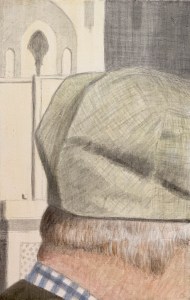
A Piece of Me #1, egg tempera on panel, 21 x 13.3 cm or 8 1/4 x 5 1/4 in.
Most of the information on egg tempera that I’ve posted on this blog thus far has referred to my use of egg tempera as an underpainting for oils. However in my most recent multi media project I’ve created a series of images painted exclusively in egg tempera, as a stand alone painting technique. This is the first time in about forty years that I have done this. So I have been both in and out of my comfort zone: there was familiarity but not mastery.
Thus I tried to create fully saturated, full value-range paintings, which in this medium can be challenging. Due to the pre-established nature of my subject matter (see link above for an explanation of the overall project), composition played less of a role: my challenge was simply to create a unified field of paint that was aesthetically pleasing. Here below are a few of the things I learned in the process:
-
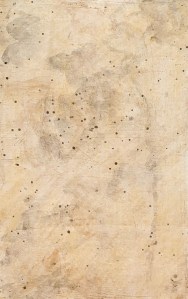
A Pice of Me #41, egg tempera on panel, 21 x 13.3 cm or 8 1/4 x 5 1/4 in.
I began each panel with a well established black and white underdrawing. Often this meant creating a detailed value study, beautiful in itself, but which also contained enough meaningful information for the three dimensional, coloured forms to come. I began by executing these studies in silverpoint but for technical reasons, which you can read about here, I had to shift washes of india ink. For this I used the brush – not the pen nib – since I felt the pen nib would create too harsh a graphical line for this incredibly subtle medium.
- I applied my egg tempera in many very light, successive washes. I especially wish to thank the contemporary egg tempera artist, Koo Schadler, for her painting insights. They helped me to improve my use of the technique in many different ways.
- Of especial help was her suggestion to use fine celled cosmetic sponges for my glazes. They helped me to achieve unified fields of wash which are otherwise difficult to achieve in this fast drying medium.
- I avoided mixing colors. All hues in the paintings (well, almost all) were achieved by superimposing layers of wash in order to achieve any particular colour. This honors the chromatic purity of each pigment as well as allows light to interpenetrate any nuanced mix of color. Strange as it might seem, even though it’s time consuming, in another way it’s also simpler, as this kind of “glazing” helped to create chromatically unified paintings.
- Additionally, and as a related point, I tried to paint with as limited a palette as possible. I kept a list of the pigments I had used on the back of each panel. I expect this to be helpful information as I move into other panels with other media to describe similar subject matter.
- Perhaps the most important understanding came in my own understanding about “light” and “white”. While many artists may advocate the mixture of white pigment (either zinc or titanium) with tempered paints – and I did experiment with that on some of these panels – I ultimately had to follow my own intuition and avoid the addition of white pigment whenever possible. This meant working up my mid tones slowly, yet fully, through a series of washes, many of which were partially translucent. As the painting gained in hue and saturation, I always tried to kept my brightest highlights clear of paint. When you paint with an indirect method like this, this is possible. It is also possible (another hat tip to Koo Schadler) because you can add significant amounts of water to your egg tempera paint without harming its internal integrity. This meant that the white of the gesso ground always served as my source of light. The difference between the intrinsically emanating light-beauty of the gesso ground to the dead weight of adding white pigment back in at some later stage is huge. So I avoid it whenever possible.
- A full view of all thirteen panels is available here.
A Piece of Me – the beginning
September 12, 2019
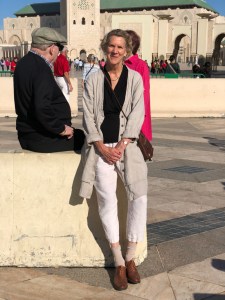
Self portrait in Casablanca outside of the Hasan II mosque.
Last week I finished the preparation of 64 identically sized panels (21 x 13.3 cm or 8 1/4 x 5 1/4 in.) for a new project. It consists of cutting up a full length photograph (which happens to be a self-portrait, see left) into 64 identically sized pieces and then painting each piece differently, so in a different medium. Since there are not 64 different mediums, in effect, I’ve reduced my approach to five: egg tempera, encaustic, the mixed technique, oils and acrylics. Preparation-wise then, each medium receives the ground appropriate to it: egg tempera receives chalk gesso; encaustic and mixed technique, ditto; while oils receive an oil ground; and acrylics, acrylic gesso. Additionally each panel receives a pre-treatment (or not) thus: plain wood (so, no treatment); linen (glued on, using rabbit-skin glue); collage (glued on, again using rabbit-skin glue); pre-textured sculpting (I used acrylic modeling paste for the acrylic and oil panels while I experimented with pastiglia for the egg tempera, encaustic and mixed technique panels). Needless to say such an approach presents a bit of a logistical nightmare but excel spreadsheets can, indeed, work miracles.
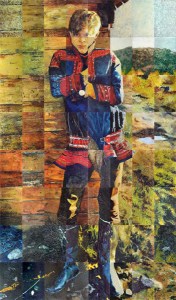
Nils, 1978, final full-sized assembled painting. 6‘ 02” x 3‘ 6” or 188 x 107 cm
Anyway, instead of this appearing to be a new direction, actually, it’s not. It’s a return to the kind of work I was doing approximately forty years ago, see “Nils” right. You can read more about that painting project here. I also did a few other smaller pieces at that time trying out that same approach and I briefly dabbled with it again (as an approach) in 2011. But after stumbling upon an appropriate photograph earlier this year, I’m drawn to return to it now with a deeper understanding of many things. So, here we go. I love how the compositions you receive with this approach are completely arbitrary and spontaneous. The challenge, as always, is to create a sensorial unity, something beautiful and interesting in its own right individually and of course, in the final assembled result.
Egg tempera revisited
May 10, 2011
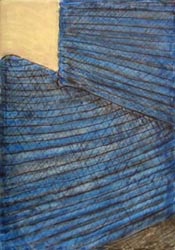
Anna, #17, egg tempera, silverpoint and india ink
Although I’m a huge fan of egg tempera, as a medium I generally use it for underpainting. It’s quick drying and relatively easy to manipulate, establishing firm graphical forms, through firm graphical brushstrokes that tend to be light in tonality. But for creating soft, smooth, subtle gradations that’s not its forte unless you have boatloads of patience. So in my book, that makes it great for underpainting, but as a stand alone medium, I’m not a purist, at least, not yet.
However, in my most recent “puzzle” painting project I planned to do just that. Each of the 25 squares involved were developed in silverpoint, india ink and egg tempera – as underpainting or underdrawing, respectively. Then, many of those panels received a further development in oil or wax or a combination thereof. But, I planned to leave 8 of thsoe panels alone remaining as a treatment in pure egg tempera, so for those 8, my skills in manipulating the medium had to suffice. Would they?
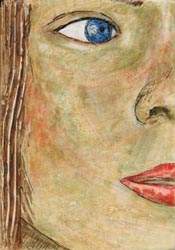
Anna, #8, egg tempera
The trickiest section by far was the face (which I left for the last). Early on I had decided to underpaint all the flesh tones with green earth, or terra verte pigment, similar to the Siennese painters of the Renaissance. (At that stage the figure looked rather ghoulish and I had to console myself that it would change.) Darker facial details were also painted with the same green earth. As I began to overlay with my warmer colors, the face came to life. Great! That particular facial square had also received some pre texturing with sculpting putty so the sculpting contributed in its own way, for example, the hair on the left only required of a few layers of burnt umber as a wash.
The final mixed media collage can be seen here.
Egg Tempera
May 25, 2009
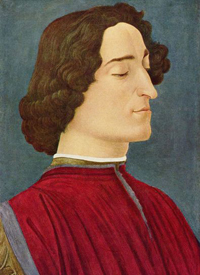
Egg tempera Medici Portrait by Botticelli
Egg tempera is an time tested technique, especially well loved by panel and icon painters. It renders flat graphical shapes and fine precise detail quite well. Softer gradual modulations are possible but take practice and patience. The unvarnished final work has an almost chalk-like finish to it. This technique formed the backbone-skill to any medieval or renaissance painter’s tool chest. The twentieth century has witnessed its revival with Andrew Wyeth being perhaps its most famous spokesman.
For anyone wishing to ask experts geeky questions about the medium check out the MITRA forum. In the past there has also been the Society of Tempera Painters (whose informative forum is currently offline). The Tempera Society had a well established site and forum, documenting many aspects of the process as well as related techniques. In its absence, I’d suggest picking up a good book and starting in. The online version of Daniel Thompson’s, The Practice of Tempera Painting is one of the most extensive sources around. Cennini is charming even if a bit antiquated in his terminology and procedures. If you are looking for something more general in order to get started, try Ralph Mayer’s “The Artist’s Handbook of Materials and Techniques”, Reed Kay’s “The Painter’s Guide to Studio Methods and Materials”, or “The Materials of the Artist and Their Use in Painting” by Max Doerner. All are tried and true comprehensive source books for the craft of painting.
Egg tempera is a paint made from an emulsion of oil and water. The final paint film is not as flexible as oil. Thus, to avoid cracking, the painting is executed on a firm and stable panel not on a stretched canvas. At the moment, I use egg tempera primarily as an underpainting. The links here on the right offer some info – by no means extensive – about how I prepare my gesso and panels.
Pigments:
Be sure to supply yourself with a good collection of dry pigments – avoiding poisonous materials whenever possible. You don’t want to breathe in toxic dust. By grinding your own paints you get to know the specific characteristics of each pigment – opacity/translucency, saturation, hydrophobic or philic, chromatic nuance. Online suppliers are very helpful if you do not live in a large city with a big art supply store. Get a thick piece of frosted plate glass and a glass muller. Otherwise a pallette knife and wooden painter’s pallette can suffice in a pinch. Grind up a small amount of each pigment you want to use in distilled water, making a smooth paste. The pastes can be stored in plastic film containers for short periods without drying out. To extend that drying out time I usually insert a piece of sponge at the top of the jar. Keeping it moist prolongs the life of the pigment paste.
The Egg:
Locate as fresh an organic an egg as you can. Crack the shell carefully in half without breaking the yolk. Carefully move the yolk between shell halves to isolate the yolk from the white (all the while protecting the egg yolk membrane from puncture). Let the white albumen drip away. Pass the yolk back and forth between the palms of the hands in order to dry it off. Roll it across a piece of absorbent paper towel for further drying. Eventually you should be able to pick up the yolk by it’s sac. Hold it over a small clean jar (empty jelly jars from hotels are great for this) and pinch the bottom. The pure yolk will drip out. Add an equal amount of distillled water, cap, and shake it. Store in the refridgerator.
Tempering the Paint:
On your glass palette add equal amounts of pigment paste and egg yolk. I use a palette knife to measure a “bean” of pigment paste and a small pipette to measure the same by dipping into my prepared egg. Mix until smooth. If you have already ground up your pigments in distilled water, then adding the egg binder now is easier and requires much less grinding. Some pigments will require more yolk, others less. To make sure you have tempered your paint correctly, Take a moistened sable brush, dip it in your newly mixed paint and lay a stroke on a nearby piece of window glass. It should dry quite quickly. Then take a one-sided razor blade and gently scrape the paint swash off. It should maintain its own consistency and curl off like a ribbon. If you have not added enough egg the pigment will return to powder and flake off. If you have added too much egg the paint film will lack chromatic saturation. Let experience be your guide. Soon you will get the knack of it.
When you are satisfied that you have tempered your paint correctly, transfer this mixture to a painting cup. I use a nested set of porcelain dishes that have a top cover. The tempered paint is rather thick, too think for painting, so at this point it is important to add additional water in order to arrive at the right mixture of pigment/yolk. How much water? Apparently, that doesn’t really matter. If your paint has been tempered correctly you can (if you wish) dilute it with large amounts of water so as to paint with many fine watercolor-like washes. As you work, it may seem as though the color is not building, but be patient and you will see that it does.
Painting:
Sable brushes dipped in this watered down paint will be too saturated for the painting stroke. Using your thumb and forefinger press the excess liquid out until the brush renders a clean full stroke without leaving behind a blob of paint at the end of the motion.
Egg tempera does well with many light thin strokes. Do not immediately rebrush a stroke. Let it dry, then add another level. Because it dries so quickly this is usually not a problem at all. In this way soft transitions can be achieved. But is is important to let your brush dance over your whole painting. Do not obsess in any one area, if it has not thoroughly dried it can become overworked and lift off earlier levels of paint, creating a hole that is difficult to repair. Stay light and playful, attentive to the whole work. Each artist decides how to use this medium to his/her own ends.
Egg Tempera Palette
May 9, 2009
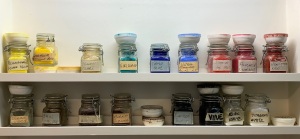
My collection of dry pigments in the studio
The list of pigments available for use in egg tempera is essentially the same as that of oil with the exception of the lead based pigments of naples yellow and flake (lead) white. They are highly poisonous and so should be avoided in powdered form. Additionally, the lead based pigments discolour upon exposure to sulphur fumes. While this discolouration can be avoided by varnishing the final picture why bother when so many other safer pigments are available today?
Powdered pigments can be quite exciting to see and to use – especially for the first time. In egg tempera, you must always work with powders that you grind up into paint for the daily session. I use a glass muller and a piece of frosted glass for this purpose. It is also possible to pre-grind a number of common colors in distilled water and keep this paste in a small airtight jar (with a moistened sponge inserted in the lid) ready for use. This saves working time and energy. This larger work of grinding up pigment pastes then needs doing only once a month or so (depending on your climate and usage). The muller and glass plate need to be thoroughly cleaned after each grinding session.
For daily painting, I usually temper (with egg) only a few pigment pastes for each session. This does not take alot of extra time or effort. A bean of pigment paste mixed up with an equal amount of egg suffices for the paint of the day. A quick test consists of stroke on a piece of smooth glass. When it dries and can be lifted by a one sided razor blade it shows itself to be an internally cohesive ribbon of colour. If it does not form a ribbon and instead dissolves into powder you have not added enough egg yolk.
My palette:
- ultramarine blue (a cool blue)
- thalo blue ( a warm blue. Exceedingly difficult to grind so it requires much patience but since it is such a beautiful colour it’s well worth it)
- cadmium yellow medium (a warm yellow)
- Permanent Lemon Yellow (a cool yellow)
- Cadmium red medium (a warm red)
- Alizarine crimson (a cool red. Another pigment that is difficult to grind but also is well worth it.)
- venetian red (red iron oxide)
- viridian green
- raw umber (fantastic for shadows)
- burnt siena (great for achieving quick grounded warmth)
- yellow ochre
- mars black (carbon black is not good for aqueous solutions)
- zinc white (good for achieving light tints that you wish to also contain some body. As my proficiency increases I tend to use this less and less. The original white of the gesso panel is all the light I ever really need – or want.)
I tend to honor spectral purity of each pigment so I usually don’t mix up colors on the palette but instead superimpose thin layers of hues to achieve a given colour.


