A Piece of Me – the beginning
September 12, 2019
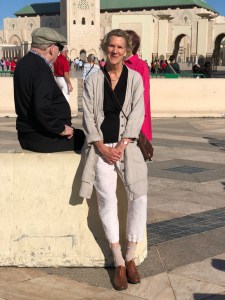
Self portrait in Casablanca outside of the Hasan II mosque.
Last week I finished the preparation of 64 identically sized panels (21 x 13.3 cm or 8 1/4 x 5 1/4 in.) for a new project. It consists of cutting up a full length photograph (which happens to be a self-portrait, see left) into 64 identically sized pieces and then painting each piece differently, so in a different medium. Since there are not 64 different mediums, in effect, I’ve reduced my approach to five: egg tempera, encaustic, the mixed technique, oils and acrylics. Preparation-wise then, each medium receives the ground appropriate to it: egg tempera receives chalk gesso; encaustic and mixed technique, ditto; while oils receive an oil ground; and acrylics, acrylic gesso. Additionally each panel receives a pre-treatment (or not) thus: plain wood (so, no treatment); linen (glued on, using rabbit-skin glue); collage (glued on, again using rabbit-skin glue); pre-textured sculpting (I used acrylic modeling paste for the acrylic and oil panels while I experimented with pastiglia for the egg tempera, encaustic and mixed technique panels). Needless to say such an approach presents a bit of a logistical nightmare but excel spreadsheets can, indeed, work miracles.
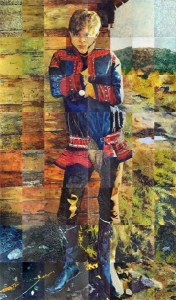
Nils, 1978, final full-sized assembled painting. 6‘ 02” x 3‘ 6” or 188 x 107 cm
Anyway, instead of this appearing to be a new direction, actually, it’s not. It’s a return to the kind of work I was doing approximately forty years ago, see “Nils” right. You can read more about that painting project here. I also did a few other smaller pieces at that time trying out that same approach and I briefly dabbled with it again (as an approach) in 2011. But after stumbling upon an appropriate photograph earlier this year, I’m drawn to return to it now with a deeper understanding of many things. So, here we go. I love how the compositions you receive with this approach are completely arbitrary and spontaneous. The challenge, as always, is to create a sensorial unity, something beautiful and interesting in its own right individually and of course, in the final assembled result.


