A non-dual definition of art
August 4, 2023
Art is: (in the Dutch language) een gevoelsmatig einheid. Period. The “gevoelsmatig” element refers to the channel of consciousness on which it vibrates, while the “einheid” element (which I’ve also written about here) refers to the unifying thrust inherent to the creative process as well as to its manner of perception.
Translated and expanded into English the definition becomes: a felt-intuition succinctly and evocatively expressed/communicated as a sense-based unity. It might be helpful to unpack that a little bit.
“felt-intuition”
The Dutch word, gevoelsmatig guides me here. I’ve written about that word (particularly in the context of Western philosophy) here and here. Gevoelsmatig refers to a sensitively refined, intuitive, instinct-type of feeling-knowing that is not only fundamental to all forms of art but to existence itself. It refers to an inception, a feeling-knowing which may be based on sensations, emotions, or impressions not entirely understood and so (at least to the subject, but also to others) may appear irrational. Nevertheless, it’s a subject-based channel for acquiring “knowledge”, self-knowledge. Birds know when to fly south, humans know when a relationship has ended: it’s gevoelsmatig.
In English I have chosen the compound word felt-intuition as a translation for gevoelsmatig instead of emotion or feelings. Using the word emotion especially to describe art would, I feel, be reductive because not all instances of art are transmissions of emotion. Rather most, if not all, speak to and through the senses, describing/communicating how some external or internal event felt to the artist, allowing the perceiver/receiver to experience something similar. (which is, by the way, a good example of non-duality) The word feelings too, is inadequate because it does not include the knowing aspect of the word “gevoelsmatig”, for the greatest art communicates a sense of meaning even – or especially if – that meaning is not entirely understood. Art can speak directly, viscerally and transcendentally to the person, to the transpersonal (mythic or religious imagery) or the supra-personal (abstraction) levels – or all three simultaneously (!).
“expressed/communicated”
Everyone experiences emotions and felt-intuitions. The artist tries to communicate such things through a process of objectification. The artist needs to be grounded in his or her own experience in order to communicate directly from it, extracting the essential. Still, not everyone possesses the capacity to objectify evanescent feelings or intuitions, that is, to recreate them effectively. Additionally, not everyone gives themselves permission to be in contact with their own deeper levels and to express from those spaces: cultural/upbringing factors may encourage attractive emotions which, when expressed as “art” become simply superficial; while those same upbringing factors may force unattractive emotions to either be repressed or suppressed. This may be the reason why the biographies of many famous artists depict their lifetimes as a series of taboo-crossings – for like many rock-n-roll icons – not every lover is left alive. Felt-intuitions penetrate deeper, are both singular and personal. Art as an expression-and-communication speaks to it all.
“succinctly and evocatively”
This is where craft of the artist comes in. Every artist knows that the less said the better, that craft means being succinct. This is true in acting, in writing, in music, in dance and in the visual arts. Art succeeds when it extracts the refined essence of an intuition or an experience so effectively that it can evoke something similar in the viewer. This allows the perceiver/receiver to experience a reconstruction within the sphere of their own feeling-world – entirely without the use of concepts. Strong emotions in the perceiver may then be elicited: surprised by joy; disturbed by fear. A discovery. A release.
“a sense-based unity”
Past definitions for art may have relied on the word “form” to describe the resulting piece. But that word is inaccurate because though that piece may very well exist as a form, as a thing, as an object, what makes it art is the fact that, it is a vibrant unity created from disparate elements: thoughts, words, feelings, sensations, movements, notes, lines or splashes of paint. These sense-based communications allow the perceiver/receiver to recreate a similar unity within themselves. (again, an example of non-duality) And aesthetic pleasure resides entirely in this: the subtle recreation of an intuition or an experience so deeply felt and communicated that we too resonate with it – entirely without the use of language-based concepts. And in addition, our lived-experience becomes enhanced by this resonance.
Prachtig! (that’s great!)
Aboriginal Culture
June 23, 2023
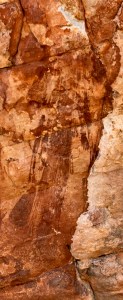
Cave painting of a dancing, ritualistic figure from Jar Island – at least 30,000 years old, if not more.
After our return from Australia and before I get on with the normal activities of our life here in Europe, I feel the need to put down some thoughts and feelings about the Aboriginal people and art that I encountered there. First, the word “aboriginal” is a Latin term, roughly translating to “from the beginning”, which was categorically applied by Australia’s white settlers in the early 19th century to distinguish between themselves and the dark-skinned natives they encountered there. But just to clarify, when the settlers arrived, there were already approximately five hundred different tribes scattered throughout the land: they spoke different languages, had different rituals, ate different food (bush tucker) and had different migration habits, depending on the climate. However, as an umbrella term, it stuck. It’s usage immediately reinforced larger cultural and racial divisions which hardened over time.
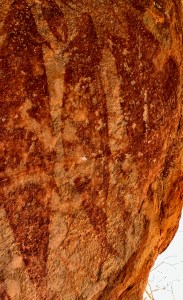
Cave painting from Jar Island – at least 30,000 years old, if not more.
The dark-skinned indigenous tribes wished to continue with their hunter-gatherer way of life, sustained by the stories which had been communicated orally (mostly in secret initiatory rites) and maintained (so they claim) in an unbroken line for tens of thousands of years. In fact, the current date collaborated to by scientific archeology places the presence of hunter-gatherers at specific locations within Australia from 50,000 to 60,000 thousand years. On encountering these “dreamtime” myths and stories, primarily through the art that continues to surface, I experienced the sense of a living connection to “Country”, the term they use to describe their sense of a land animated by Spirit-Gods, immanent within the animals, birds, plants, trees, insects, rocks, water and wind. It’s an animistic group-identity connecting these people to each other and to the land through customs prescribed by the Law (the moral precepts) given to them by the first Spirit-Gods.
In contrast, the white-skinned settlers, mostly farmers and miners, were interested in the open land of the New World. They were part of the European colonial expansion already sweeping the globe. In this case, in Australia and especially in the 19th century, Britain laid claim to a land they conceived of as being empty (terra nullius). They brought with them their culture – and more effectively, their civilization. As in other areas of the New World, an orally transmitted culture of hunter-gatherers was no match to the technologies of civilization: guns, money, law, agriculture, houses, roads, and a unified and unifying language cemented by Gutenberg’s books. It was an inevitable and unstoppable wave which ultimately resulted in an indigenous culture becoming extracted from the sustaining conditions of its generation and relocated to settlements on the edges of the white fellas’ world.
Racial differences, of course, were easy markers, signposts of the deeper cultural contrasts within. In some places assimilation proceeded gently with the help of missionaries introducing the natives to their (Christian) God, agricultural methods and language (English). In other places, for a continent peopled at least in part by Victorian society’s rejects (the penal colony prisoners), the transition was much harsher. Also, and at the same time, mere physical contact with the white man meant an introduction to his diseases (things like polio, diabetes and alcoholism just to name a few). It was catastrophic to the isolated and genetically unprepared immune systems of these tribes. Thus, over approximately two hundred plus years, the attrition brought on by war, disease and displacement caused profound challenges to the identity of these people. Within the settlements, there was not only a decimated population, there was also a listlessness and general lack of purpose which at times threatened to wipe these people off the planet. The story could have stopped there but it didn’t. There’s always a swing of the pendulum.
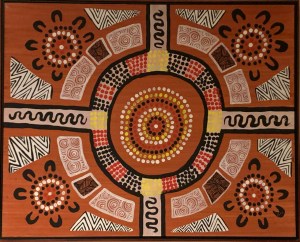
Aboriginal art from our hotel room in Broome.
Over the centuries, as cultural assimilation (slowly) proceeded and an aversion to (overt) racism grew, the more difficult challenge of overcoming cultural chauvinism loomed (and still does, though to a much lesser degree). The later half of the twentieth century had seen a general increase in public interest for the situation of the indigenous Australians, while for the latter, through the more general acquisition of the English language as well as becoming educated in Australian law, came the opportunity to challenge it. At root is/was the issue of ownership: political ownership and/or cultural ownership, where they meet and where they do not. In Australia, as culture and politics slowly change, two events of the last fifty years stand out.
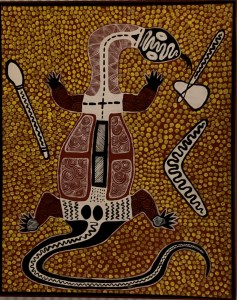
Aboriginal art from our hotel room in Broome.
The first change was cultural. Sometime in the 1970’s, when an art teacher (Geoffrey Bardon) in an indigenous settlement north and west of Alice Springs (Papunya) noticed his young students drawing patterns in the sand, he encouraged them to paint and draw these forms and shapes – which they did. Before that they had been copying the images of cowboys and Indians from TV and films. Soon the elders, who had been watching from the sidelines, began requesting paint and canvases for themselves, too. “Aboriginal art”, as a movement, had been born. That’s a simplistic explanation – and from an external perspective – but perhaps for an indigenous human being steeped in Dreamtime stories (invoking a reality perceived as concurrent to the conditions of life within the shacks of a settlement) turning to these stories was like turning on the spigot to a source of fresh water: easy, natural, and virtually effortless. For myself, as both philosopher and artist, I tend to think that if it had not been for Picasso, Freud and/or Jung impacting the world of western culture in the early part of the twentieth century as they did, what was and is being communicated from the sidelined Aboriginal cultural world would not have received the appreciation that it has. For example, besides exhibitions in major galleries and art centers around the world, currently there is a wing dedicated to Aboriginal art in the National Museum in Canberra.
The second event, just as transformative, was political. In 1992, in the Mabo vs Queensland decision, the Supreme Court of Australia overturned the terra nullius precedent which had been used by England to justify its seizure of land during the continent’s colonial era. Challenging this precedent had put the Indigenous People in the strange position of needing to prove something legally that – but for vested interests – was generally acknowledged as common-sense. In 1993, this decision was quickly followed by the Australian Parliament’s passing of the Native Title Act. The NTA sought “to provide a national system for the recognition and protection of native title and for its co-existence with the national land management system”. Of course, the devil was in the details. As a Belgian lawyer once quipped to me: “Possession is nine tenths of the law”. So, the NTA opened the door but did not grant entry. Legal challenges continue to be an ongoing process within the states and territories: claims are mounted for landmarks deemed especially valuable to the local tribes; citizens, mining companies and pastoral concerns fight back. Thus you have, in modern day Australia, an on-going political/legal situation. Who owns what? And who has the right to decide it?
During our visit in May 2023, before a classical music concert in Sydney, we were surprised to hear an acknowledgement of tribute to the local tribe as traditional owners of the land on which Sydney’s Opera House stood. Later, the same occurred in Perth. On the entry walls in the Art Museums of both Sydney and Perth, we read the same – in so many words. During our stay in Perth, we noticed banners proclaiming 2023 as the “Year of Reconciliation”. While on a Friday, as we traveled by bus to King’s Park we encountered a number of young friendly Aboriginal kids excitedly journeying to the “Walk of Reconciliation”, a festival taking place there that day. As we wandered through the park’s natural beauty, we noticed stations set up for demonstrations of indigenous music, dance, painting, pottery, weaving and bush tucker. Cool.
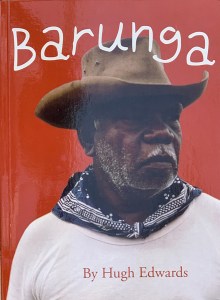
Albert Barunga by Hugh Edwards.
Later, in our hotel, I finished reading the biography of a native man named Albert Barunga. I had picked it up after conversing with his grandson, Warren Barunga, in a shack off Freshwater Cove in the Kimberley. There, Warren was selling a few books, his art-work and that of some other clan members. His grandfather, Albert Barunga had been an Aboriginal man raised in the bush sometime during the 1920’s. Later he was educated by missionaries. During his lifetime he had achieved success through his ability to function well in both worlds. He helped to translate parts of the New Testament into his native Worora tribal language. He was skilled in managing horses, boats and people and worked as a scout for the Australian navy in WWII. Later he functioned as an advocate for his tribe. In 1977, he and his wife were invited to meet the Queen of England when her yacht was moored off the coast. Though the book was an interesting biography, documenting the particulars of a transition from a hunter-gatherer way of life to a (western) civilized one, one passage in particular stood out to me. It highlights a difference in the method-of-knowing emphasized by these contrasting cultural environments.
He described an experience which occurred during the Second World War. He was about to board a Catlina flying-boat airplane heading out on patrol. He had never flown before and so was excited about the opportunity, however as he approached the plane, a cold feeling came over him. His aversion was noticed by the Captain who simply suggested “Perhaps another time, Albert”. So, he remained behind, despondent at his “failure”, only to hear hours later that the plane had been shot down by the Japanese, losing all fifteen crew members. He remembered then the cold feeling and concluded: “something told me it was a death ship. I can’t explain what it was. […] This kind of feeling is not uncommon with Aboriginals. A sixth sense, the white men call it. When I was younger and closer to the bush I had it much more strongly. [..] But the white man has rubbed across my brain and these sensitive things have gone. Now we are away from our own country, the spirit-feelings don’t come back.”
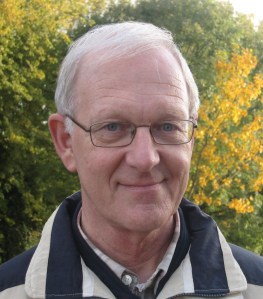
Douwe Tiemersma
Douwe Tiemersma, our Dutch-language-based teacher of non-duality, earned an interdisciplinary PhD in the fields of biology and philosophy. So of course he was an accomplished scholar within reason-based methods-of-knowing. But as a teacher of non-duality and a lifelong practitioner of yoga and meditation, he was particularly keen to emphasize the importance of a gevoelsmatig kind-of-knowing. Gevoelsmatig then refers to a sensitive, intuitive, instinct-type of feeling-knowing that is not only fundamental to all forms of art but to existence itself. For my husband and I, as his English language translators, we often found it difficult to translate the word “gevoelsmatig” into English – using just one word. It refers then to an inception, a feeling-knowing which may be based on sensations, emotions, or impressions not entirely understood and so (at least to the subject, but also to others) may appear irrational. In Dutch, “gevoelens” are feelings, “gevoelig” refers to being sensitive, so these channels of communication play a nuanced role in the word “gevoelsmatig”, however in English, if you use “instinct” or “intuition”, the main etymological clue is the prefix “in”, which points internally without much of a clue about which channel of communication may be involved. Additionally, if you use “feeling” or “emotion”, the sense that it is a subtle mode of intelligent communication may be less apparent.
Also, as Albert Barunga noticed about his intuition, it’s something that an individual (and his or her living conditions) can either encourage or discourage – but never entirely eradicate. It creeps up on us in our dreams, the shadowed world of our daytime neglect. The non-dual perspective suggests it’s intrinsic to human nature and complimentary to reason. On the cultural level then this tends to surface as our collective and recurring myths. Thus, within western culture, particularly in the twentieth and twenty-first century, as science and philosophy have proceeded to demythologize religion, Picasso, Freud, Jung and now Aboriginal art, through psychology and art, have given myth a heightened value. To a mind focused exclusively on reason as a method-of-knowing, subtly felt intuitions may appear as magical thinking, yet to a mind open to alternatives, a good intuition may indeed tell reason where to dig. To my mind it’s a question of balance, personally and culturally.
Colour by Victoria Finlay: a book report
June 13, 2021
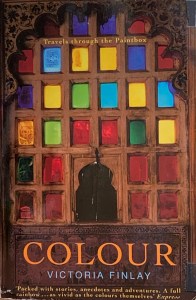
Colour by Victoria Finlay
I recently reread this treasure from my book shelf. It was as entertaining now as it was almost fifteen years ago at my first discovery. For anyone interested in colour, professional or otherwise, I highly recommended it. It’s written by a well informed storyteller, who roams the planet in search of the animal-vegetable-mineral sources that have been used for centuries to express the rainbow spectrum of human thoughts, tactile feelings and animating emotions. It’s about pigments then, as well as their wearable counterparts in the form of dyes.
Although the book itself is light on theory, the author organises her material according to the spectrum of RGB additive light (I wrote about that a few years ago here). That theory recognises white light as the cumulative ‘colour’ achieved by adding together the separated spectral components of red, green and blue light. Additive light theory exists in contrast to subtractive. Subtractive light/colour theory states the opposite, that is, the cumulative ‘colour’ achieved by adding its primaries (red, yellow and blue paint) is black. Subtractive light/color exists in the world of reflection, such that whatever colour we perceive is actually a reflection of the spectral wavelengths that any particular object does not absorb. For example, an apple absorbs mainly green and blue light, so it reflects red. We learn to mix the colours of subtractive light in kindergarten while later on we experience the more sophisticated cyan-magenta-yellow-black of commercial printing.
Since we are all children of light, internally I think we dream in coloured light (that is, in additive light), even though when we start to create (or recreate) those internal images on opaque and reflective surfaces, we use subtractive colour mixing. We try to travel back up the rainbow. That’s why the final result of even a well crafted image can often be disappointing – at least to the artist – for it never quite matches the inner imagination. In any case, it’s important to be aware of both models. Clearly Victoria is guided and inspired by the rainbow colours of additive light, while she so passionately explores the materials of the earth which reflect its hues subtractively. There’s a story here, too, for many of these organic dyes and inorganic minerals are increasingly being replaced by their synthetic counterparts. Qualitatively, the differences may be great or they may be small, so much depends on subtlety and the test of time. Thus, though she doesn’t seem to have an axe to grind, she knows what she likes.
The tales of this itinerant traveler then make for an appealing and not too technical read. She is imaginative and more adventurous than many (for example, she traveled in the early 2000’s to areas of Taliban-ruled Afghanistan in order to see its storied mines of lapis lazuli). I especially appreciated her recognition of the importance of tactile sensitivity – in the creation of art – and in the discovery of the materials it uses. She states:
“When we see a finished painting we tend to assess it for such things as composition, emotion, colour and perspective. But what the artist experiences moment by moment in his or her turpentine-smelling studio is the scrape or smear or splatter or stir of one substance against another. Does the artist think of butter or tiramisu or of diesel as the paint is applied? Or does the laying down of paint happen without mental images at all? It depends, of course, entirely upon the individual. But either way, painting is sometimes an entirely tactile act where time is forgotten, and it is sometimes a paint’s ability to drip – or not to drip- and the colours it goes with rather than its propensity to poison which has been the deciding factor in whether it is welcomed on the painter’s palette. As James Elkins writes in ‘What Painting Is’, where he explores the parallels between painting and alchemy: ‘A painter knows what to do by the tug of the brush as it pulls through a mixture of oils, and by the look of the coloured slurries on the palette'” (pg. 146)
I call this factor the muladhara chakra, or gevoelsmatig bewustzijn or aesthetic consciousness or quite simply, like Victoria, tactile sensitivity. In any case, in this sense she’s clearly a writer after my own heart.
Gevoelsmatig Bewustzijn, Part I
November 15, 2020
I want to talk about something that Western Philosophy, for all its wisdom and logical acumen, has difficulty defining. Yet for all that it’s an essential part of human being-existence. I’m using the Dutch phrase for it in the title above so that the English language speaker has the chance to consider that they are not entirely sure what I am talking about. Imagine then, that this is something new (in terms of conceptual definitions) though in fact it is something quite old or rather, simply deeply innate to human nature. “Gevoelsmatig”, refers to the feeling capacity of a human being. And “bewustzijn” refers to consciousness. Joined together, as a concept-phrase, it suggests that there is feeling dimension to consciousness, or alternatively, that there is a consciousness dimension to our feelings. How can that be? If you image consciousness as an expansive realm and at the same time you imagine the feeling body of a human being to stop at the edges of the skin, it appears to be an insoluble contradiction. Yet our own experience demonstrates otherwise; we expand on extremely refined levels in our feeling-sense every day – and in a myriad of different ways.
For myself, as a native English speaker, it has taken me years to wrap my head around the phrase “gevoelsmatig bewustzijn”, to understand it, to relax into it and see examples of it in my own experience. At first it required a certain kind of linguistic de-programming. That is, language was a deterrent and then later an aid. There were a number of reasons for this, so I’ll try to explain. My difficulties may be helpful others?
Firstly, “gevoelsmatig” as a stand alone term does not have a one-to-one translation from Dutch to English. It requires a few words to define it. I currently use “feeling-sense” or “felt-intuition”. A Dutch friend of mine (who is also fluent in English) suggested “feeling-wise” as an adjective for a kind of knowing. Google translate uses “instinctively” or “emotionally” while VanDale (one of the main Dutch-English dictionaries) suggests “instinct” or “instinctively”. Thus, gevoelsmatig can refer to the kind of knowing that a bird experiences when it “knows” it’s time to fly south. In the world of nature there are a multitude of examples. Animals “know” all kinds of things and this kind of knowing is not based on language. It is not rational, neither is it irrational; it’s a certain kind of embodied intelligence.
But what about humans? How does this instinctive feeling-knowing manifest in human beings? As instinct? As intuition? As insight? A mixture of all three? Notice, in any case, that all three suggestions contain the prefix “in”. Thus, this refers to the internal, subject dimension of knowing. The objectifications of language are not its medium, nor its method of cognition, though the knowledge it acquires may later be expressed that way. As noted above in the animal world, it is not rational, yet neither is it irrational; for us too, it is not rational, neither is it irrational. It’s a certain kind of embodied intuitive intelligence. For example, a friend walks into the room and you immediately know they are sad. From one point of view, it’s that simple. Over thinking it (which of course philosophers love to do) just makes it more complicated. This explanation then, is not a logical proof, instead, it’s based on recognition.
Secondly, what about “consciousness”? As a stand alone term Merriam Webster defines it as “sentience or awareness of internal or external existence”. But problems quickly multiply when we try to define it further. Notice first that in the Webster definition, the contrast of inner or outer is presupposed – and the edges of our skin provide that all important dividing line. Further, Western culture and philosophy speak of “consciousness” in terms of “consciousness of”. Consciousness then refers to that aspect of ourselves which knows of internal or external events as objects and because of that, consciousness sits in contrast to those objects. There is an unquestioned/presupposed subject who is aware of all these internal or external events. When the Western philosopher states: “I am conscious of my thoughts” he or she projects an egoic- consciousness as the the unquestioned knower. And due to this division, within Western philosophy, it’s not possible to speak of the subject dimension (the “I” part) of consciousness without reference to its internal mental objects (the ego and its objects).
Additionally, in a world where the “objective” scientific method-of-knowing reigns supreme, Western philosophers are busy contemplating the “Hard Problem of Consciousness”. This involves the problem of explaining why any physical state is conscious rather than not. This problem begins from the presupposition that matter precedes consciousness, that it is dead, inert, non-living. That it is not conscious, is not intelligent in/or to some degree. To truly step outside of that problem would require an inversion of it: to propose instead that consciousness precedes matter. For this, a different method-of-knowing is required, something other than the object oriented, language based methods of knowing. Is there/are there such methods?
In German and Dutch “bewust”, means aware, and “zijn (in Dutch)” (or “sein” in German), means being. That is, being-awareness or aware being. If it were possible to take the meaning of these compound elements full stop, there could be a recognition of an indwelling, pure, non-object oriented being-awareness. Being without fixing, fixating, on an object – any object, even ourselves. We rest in this sphere every night in deep sleep. We revert to it (absently or not) in-between thoughts. It forms the basis and goal of every meditative technique or inquiry. It is infinitely expansive, like space itself and provides the substrate for all our perceptions and inceptions. As before with the term “gevoelsmatig”, this explanation is not a logical proof, rather it’s about recognition.
A third reason for my difficulty in grasping the meaning behind the term “gevoelsmatig bewustzijn” is the strong mind-body dualism present within Western culture (and philosophy). For people (like myself) who have embraced a spiritual path, there may be a strong impetus to encounter the more refined aspects of our subject-consciousness through meditation and prayer, free, or free-er from the unrefined impulses of our material nature. This can lead to their suppression and/or repression (spiritual bypassing). The instinctive impulses of the body then might be placed in various shadowed categories. To suggest philosophically that the gevoelsmatig impulses of our nature are vitally important in order to progress spiritually might appear blasphemous or simply difficult to accept. Further, even though this (apparently) shadowed side of human nature cannot be denied, it might sit outside the norms of accepted cultural behaviour, making its recognition difficult. Art can play a large role in bringing these shadows to the surface, creating a field for acknowledgment and acceptance.
Thus at this point you might counter and say that this expanded feeling-sense capacity of consciousness is not at all unrecognised or absent from Western philosophy or culture. Of course not. We do recognise that as human beings we joyfully expand in many non-rational and yet still deeply intelligent ways. One primary example of this is the world of art: the visual arts, but also music, dance, film, literature, poetry etc… Another is the overwhelming love we experience by allowing ourselves to fully open up to the beauty of the natural world, in all of its micro and macrocosmic majesty. But are these venues considered to be knowledge bearing? Are they included within a standard approach to Western Epistemology? No, not really. Any self-respecting Epistemology 101 in any department of philosophy around the world concerns itself with the truth bearing possibilities of propositional statements. There, young epistemologists are encouraged to be clever enough so as to one day propose the next Gettier problem. Yet, to be fair, Western Epistemology, does indeed present the possibilities of a radical skepticism, but if so, this is done as a negative pole only without a recognition of the life enhancing properties of a subject-based non-conceptual method-of-knowing.
Now, since the recognition of art has become an important venue for non-conceptual methods of intelligent communication, we might think of gevoelsmatig bewustzijn as equivalent to “aesthetic consciousness”? Is it comparable? And what does Western philosophy have to say about that? Is it knowledge bearing? And if so, what kind of knowledge?
On Photography
November 14, 2020
I’ve had a love/hate relationship with photography my whole artistic life.
OK. Confession over.
Here’s why.
A Pice of Me #41, egg tempera on panel, 21 x 13.3 cm or 8 1/4 x 5 1/4 in.
I grew up with copies of Life Magazine on our family coffee table. Their black and white photographs were stellar. Later I became entranced by other coffee table discoveries: Matthew Brady’s (high contrast) photographs of the Civil War; Edward Steichen’s 1955 exposition called The Family of Man; Diane Arbus’s haunting, disturbing photographs, the list could go on, but I’ll stop. In short, I loved photographs.
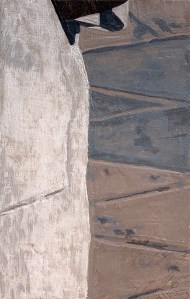
A Piece of Me #38, encaustic on panel. 21 x 13.3 cm or 5 1/4 x 8 1/4 in.
Later as a young artist I had no problem riffing off of photographs and commercial material. This is the the world; this is my reaction to it. It was a lot of fun. I loved playing with found images, basing my art upon them (not paying attention to those nasty copyright issues, but that is indeed another story). I was inspired by Photorealism and the work of Chuck Close. Over time, as I visited museums and my own artistic interests and capacities grew, I wondered how artists had been able to render external reality so precisely – in those pre-photographic days. And I realized the depth of my inexperience. Sure, I could draw. Sure, I could paint. Sure, I could play off of a photograph or some printed object. But so what? How in the world did those artists construct huge, I mean huge, canvases filled with evocative swirling figures? And all out of their own imagination? As an American raised in the era of television (where my visual imagination was continually fed by external commercial sources) I felt my poverty.
So I embarked on an internal and external exploration. I vowed to base my work only on renderings from life, from the external world around me. In this, my realistic temperament reigned. Such old school realism may now be considered anachronistic or reactionary (which it is): we already know that; you are not saying anything new. So be it. Nevertheless in this way and on this path I wanted to eschew photography, at least as a basis for image creation. Whenever I did consult a photograph (as a secondary visual resource) I realized a very important thing: a photograph is a two dimensional rendering of a three dimensional reality. Period. It can never, ever give you information that you yourself do not already possess. So I began to hate photographs, well not really, what I really hated was my own lack of formal training. Because in a traditional sense, much of what an artist does, in basing their image from life, is formal, it’s about perceiving with your own gevoelsmatig bewustzijn (aesthetic consciousness) a three dimensional form and rendering that onto a two dimensional surface. While a photograph is actually the reverse: it’s a two dimensional piece of paper that has mechanically captured a moment of life in space and time. Form doesn’t enter into it.
Then one day, to my surprise, I found myself basing a new painting project on a photograph(!). Relative to the aesthetic world that I had assigned to myself for these last decades, it was a kind of blasphemy. Because rule number one for artists seeking to do representational art is that the image should be based on a figural sitting or a study from real life (not a photograph). Well, apparently, my self-assigned apprenticeship was now over.
I cut up this photograph and started making panel paintings from the individual pieces. (I’ve included a few samples here, left and right) Compositionally, many, if not most, were abstractions or quasi-abstractions. Thus, rule number one for artists creating abstract art is that the image does not attempt to represent an accurate depiction of a visual reality but instead uses shapes, colours, forms and gestural marks to achieve its effect. Most of the panels were abstract paintings first and foremost and (contributions to) a visual reality second. This whole project then would be something in-between. For want of a better term I began to call it Deconstructed Realism.
The only thing I have to say about it all now, as I near completion, is that my self-imposed formal training in drawing from life, as well as my self-imposed training in exploring an indirect painting technique during this time served me well. By paying a lot of attention to form I was (for the most part) able to avoid that lack-of-form-information-problem from my base photographic image. I happily strove to insure that the shapes, colours, forms and gestural marks in each panel would carry its own weight. And that the final assemblage (which really is half-painting and half-sculpture) would ultimately speak for itself. I hope to be able to post images of that final assemblage soon.
Abstraction or realism: a false dichotomy?
August 31, 2020
I think any artist functioning in the twentieth/twenty-first century has had to (at least self-reflexively) address the apparent dichotomies of approach between abstraction and/or realism. Are they really as separated as they might at first appear? Personally, I don’t think so. If anything, it’s more a question of scale. Let me explain.
About forty five years ago, during my art school days, while viewing a Rembrandt self portrait in Boston’s Museum of Fine Arts, I had a sudden flash of insight. I realised that if you took a square inch (or two) of that painting and expanded it exponentially you might end up with a piece of modern art. Place it on the wall and voila! Just like that. But that wouldn’t work for just any painter. It would only work for someone who was a master of their craft; someone whose play of light and shadow did not ignore visual interest or luminosity in any part of the surface’s value range; someone whose sense of colour and texture appealed to the senses in a magical way; someone who left enough hints on the painting’s surface such that you, through your act of perceiving, could be left guessing, sure of your own experience, less sure of its (conceptual) meaning.
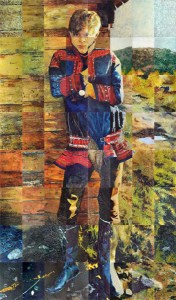
Nils, final full-sized assembled painting. 6‘ 02” x 3‘ 6” or 188 x 107 cm
I took that insight and dove directly into learning about the materials artists have traditionally used to create paintings. I figured then, as I do now, “it ain’t what you paint but the way how you paint it”. Thus, rather than create a number of paintings based on one particular (simple) image but interpreted in different ways (like Josef Alber’ Homage to the Square, Warhol’s soup cans, or Jasper Johns’ American flags), I took one strong central image, cut it into identical parts and rendered each one separately. Each part was intended to function independently as a painting in its own right yet also to contribute to the unity of the whole. That, at least, was the theory, which worked out relatively well at the time (see linked image to the left). Yet of course becoming a master of one’s materials is not an overnight process, it’s much less dependent on a flash of insight than it is upon years of experimentation, dedication, hard work and synchronistic luck (you can’t discount that!). Ultimately that means you guide the materials (and the happy accidents). You do not control them and likewise they do not control you. For in whatever creative process any artist may be involved in, there’s always a symbiosis between the impulse and the materials; there is selection based on discrimination.
Fast forward forty five years and I can now say that I have learned a few things about what makes a painting, any painting, a good painting. One, it’s not about the subject matter in an absolute sense, it never is and never has been, that’s secondary. That’s not to say that the subject matter may inspire the artist. It can and it does, but that doesn’t make it art. What makes it art is the ability of the artist to communicate his or her feeling-experience to you the perceiver in such a way so that you feel it too. Note, the emphasis on two words, “communication” and “feeling”. Which brings us to the second point about what art actually is. I would now say that art, any art (including a good painting) is a felt-intuition succinctly and evocatively expressed/communicated as a sense-based unity. Full stop. Concepts may follow but are entirely secondary. In that sense then, realism and/or abstraction as modes of expression present a false dichotomy.
One possible reason that such a definition has been lacking is that Western philosophy has been slow to recognise that there is a universal dimension to the feeling-intelligence present within all sentient beings. That the subject-based dimension of consciousness can indeed present an aspect of universality, however veiled it may be. It reveals itself daily within the human being as the feeling aspect of consciousness. So, stay tuned for Aesthetics Part I: Gevoelsmatig-Bewustzijn.
Well…
April 27, 2012
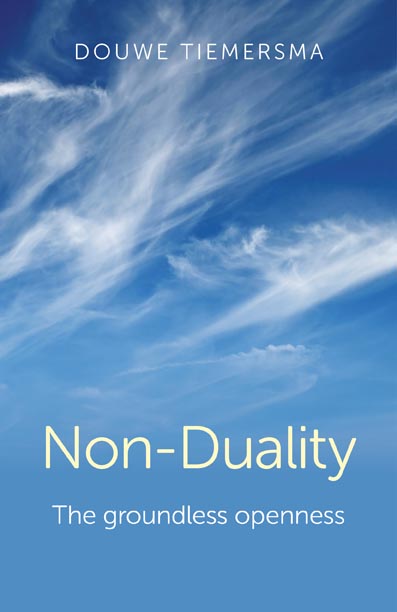 It took us two years – and steady collaboration with the author – to translate the nuts and bolts of Douwe Tiemersma’s book Non-Dualiteit, de grondeloze openheid into English. You know, we just wanted to understand what he was actually saying(!). It took another year of judicious editing to arrive at a manuscript that was attractive to a publisher. Last November we were lucky enough to sign a contract with John Hunt Publishing. They plan to publish it soon under their Mantra imprint.
In these intervening months I have done another round or two of author editing after also reviewing the publisher’s copy editing. Now the manuscript has been finalized and real production begins. Though it is hard to predict when it might actually hit the streets, six months from now is a reasonable guess. Luckily the publisher will handle all the marketing and distribution (efforts and costs) – and yes, when the time comes for it, the book should be available on Amazon. Look for it, read it and write a review if you find yourself inspired to do so.
For more information about Douwe and groundless openness you can check out his English language blogsite: http://thegroundlessopenness.wordpress.com/
I’m in!
March 20, 2011
Yes, it’s true, it’s official. I am now a published author! Sure, writing to your own blog can be a form of self-mandated soap boxing, but now two different and independent online publications have each published one of my essays.
The first (chronologically) is PSYART, on online journal dedicated to a psychological study of the arts. You can find the journal here. I’m currently listed in the top left place on the home page, next to a short abstract on the right describing the contents of the essay. You can click on the title, “The non-duality of self-expression” to read the full article.
The second publication is Non Duality Magazine, a non-profit online journal dedicated to an ongoing investigation into self-realization, awakening and consciousness itself. My article has been included in the Art section of volume 4. I find Non-Duality Magazine to be a very clean and clear representative of the the depth and breadth possibilities available within the realm of self-investigation. I highly recommend surfing through the current issue as well as all three previous volumes.
My essay occurred in its original form as a blog post about a year ago, arising from a combination of at least two elements that I’m aware of: my translation activities on a book about Non-Duality (we’re currently looking for a publisher for the completed manuscript so – hopefully – more to come on that soon) and a painting I was working on at that time. That original post has now been updated to reflect the most recently revised version so that those who wish to comment on the article can easily do so. All comments are welcome!
The Inside-Out: final version
October 17, 2010
A few years ago I located a couple of carpenters who spoke enough English (and were pretty good at sign-language) to readily understand what I wanted them to create. A few weeks later they contacted me, “het is klaar” (it’s ready). My concept: I wanted to create a two sided painting (on a wooden panel) with a rotating inner core. The core needed to be extractable duing my creation process but afterwards could be fixed (permanently) in place.
 But why create two paintings on one panel? It’s a ton of work. And what would be the reward? That’s very hard to say, except this: it’s a clear and definite way to demonstrate relation. Relation of what to what? You choose, but of course it offered the fundamental and very pregnant possibility of contrasting realism with abstraction in a direct and visceral way. For one side, I chose a landscape. A realistic, almost academic landscape based upon a value study of one of my favorite views of the Predijkherrenrij here in Bruges, Belgium.
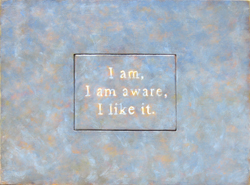 And for the other side? Initially, and for a long time, I planned on an open blue field containing a text from Nisargadatta Maharaj, “I am, I am aware, I like it.” My thinking was simply this: if you have to use words to convery your intent, then these words from Maharaj summarize just about all that you ever really need to know. So, that’s what I created.
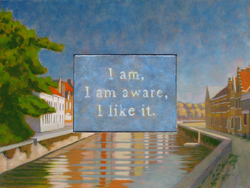
The Inside-Out
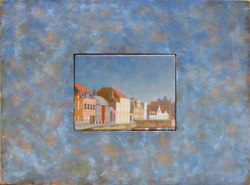
The Outside-In
When the inner core was rotated, it offered views as seen here left and right:
Thus, so far so good, kinda, but the text really bugged me. It took up way too much mental activity – thus creating a tendency to negate not only the unique mental-activity-bypass possibilities of the visual arts, but also the inner intent of the quotation itself! So last week, I painted over the text, to render a pure open field of blue. Ahhhhhh…
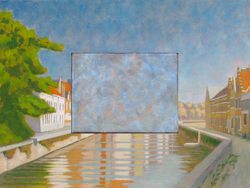
The Inside-Out revised
The Outside-In
When the inner core was rotated into “reality” I got this revised version as seen here left and right. Double ahhhhhhh……. Mucho bueno.

 Atelierartisanal's Blog