Gevoelsmatig Bewustzijn, Part I
November 15, 2020
I want to talk about something that Western Philosophy, for all its wisdom and logical acumen, has difficulty defining. Yet for all that it’s an essential part of human being-existence. I’m using the Dutch phrase for it in the title above so that the English language speaker has the chance to consider that they are not entirely sure what I am talking about. Imagine then, that this is something new (in terms of conceptual definitions) though in fact it is something quite old or rather, simply deeply innate to human nature. “Gevoelsmatig”, refers to the feeling capacity of a human being. And “bewustzijn” refers to consciousness. Joined together, as a concept-phrase, it suggests that there is feeling dimension to consciousness, or alternatively, that there is a consciousness dimension to our feelings. How can that be? If you image consciousness as an expansive realm and at the same time you imagine the feeling body of a human being to stop at the edges of the skin, it appears to be an insoluble contradiction. Yet our own experience demonstrates otherwise; we expand on extremely refined levels in our feeling-sense every day – and in a myriad of different ways.
For myself, as a native English speaker, it has taken me years to wrap my head around the phrase “gevoelsmatig bewustzijn”, to understand it, to relax into it and see examples of it in my own experience. At first it required a certain kind of linguistic de-programming. That is, language was a deterrent and then later an aid. There were a number of reasons for this, so I’ll try to explain. My difficulties may be helpful others?
Firstly, “gevoelsmatig” as a stand alone term does not have a one-to-one translation from Dutch to English. It requires a few words to define it. I currently use “feeling-sense” or “felt-intuition”. A Dutch friend of mine (who is also fluent in English) suggested “feeling-wise” as an adjective for a kind of knowing. Google translate uses “instinctively” or “emotionally” while VanDale (one of the main Dutch-English dictionaries) suggests “instinct” or “instinctively”. Thus, gevoelsmatig can refer to the kind of knowing that a bird experiences when it “knows” it’s time to fly south. In the world of nature there are a multitude of examples. Animals “know” all kinds of things and this kind of knowing is not based on language. It is not rational, neither is it irrational; it’s a certain kind of embodied intelligence.
But what about humans? How does this instinctive feeling-knowing manifest in human beings? As instinct? As intuition? As insight? A mixture of all three? Notice, in any case, that all three suggestions contain the prefix “in”. Thus, this refers to the internal, subject dimension of knowing. The objectifications of language are not its medium, nor its method of cognition, though the knowledge it acquires may later be expressed that way. As noted above in the animal world, it is not rational, yet neither is it irrational; for us too, it is not rational, neither is it irrational. It’s a certain kind of embodied intuitive intelligence. For example, a friend walks into the room and you immediately know they are sad. From one point of view, it’s that simple. Over thinking it (which of course philosophers love to do) just makes it more complicated. This explanation then, is not a logical proof, instead, it’s based on recognition.
Secondly, what about “consciousness”? As a stand alone term Merriam Webster defines it as “sentience or awareness of internal or external existence”. But problems quickly multiply when we try to define it further. Notice first that in the Webster definition, the contrast of inner or outer is presupposed – and the edges of our skin provide that all important dividing line. Further, Western culture and philosophy speak of “consciousness” in terms of “consciousness of”. Consciousness then refers to that aspect of ourselves which knows of internal or external events as objects and because of that, consciousness sits in contrast to those objects. There is an unquestioned/presupposed subject who is aware of all these internal or external events. When the Western philosopher states: “I am conscious of my thoughts” he or she projects an egoic- consciousness as the the unquestioned knower. And due to this division, within Western philosophy, it’s not possible to speak of the subject dimension (the “I” part) of consciousness without reference to its internal mental objects (the ego and its objects).
Additionally, in a world where the “objective” scientific method-of-knowing reigns supreme, Western philosophers are busy contemplating the “Hard Problem of Consciousness”. This involves the problem of explaining why any physical state is conscious rather than not. This problem begins from the presupposition that matter precedes consciousness, that it is dead, inert, non-living. That it is not conscious, is not intelligent in/or to some degree. To truly step outside of that problem would require an inversion of it: to propose instead that consciousness precedes matter. For this, a different method-of-knowing is required, something other than the object oriented, language based methods of knowing. Is there/are there such methods?
In German and Dutch “bewust”, means aware, and “zijn (in Dutch)” (or “sein” in German), means being. That is, being-awareness or aware being. If it were possible to take the meaning of these compound elements full stop, there could be a recognition of an indwelling, pure, non-object oriented being-awareness. Being without fixing, fixating, on an object – any object, even ourselves. We rest in this sphere every night in deep sleep. We revert to it (absently or not) in-between thoughts. It forms the basis and goal of every meditative technique or inquiry. It is infinitely expansive, like space itself and provides the substrate for all our perceptions and inceptions. As before with the term “gevoelsmatig”, this explanation is not a logical proof, rather it’s about recognition.
A third reason for my difficulty in grasping the meaning behind the term “gevoelsmatig bewustzijn” is the strong mind-body dualism present within Western culture (and philosophy). For people (like myself) who have embraced a spiritual path, there may be a strong impetus to encounter the more refined aspects of our subject-consciousness through meditation and prayer, free, or free-er from the unrefined impulses of our material nature. This can lead to their suppression and/or repression (spiritual bypassing). The instinctive impulses of the body then might be placed in various shadowed categories. To suggest philosophically that the gevoelsmatig impulses of our nature are vitally important in order to progress spiritually might appear blasphemous or simply difficult to accept. Further, even though this (apparently) shadowed side of human nature cannot be denied, it might sit outside the norms of accepted cultural behaviour, making its recognition difficult. Art can play a large role in bringing these shadows to the surface, creating a field for acknowledgment and acceptance.
Thus at this point you might counter and say that this expanded feeling-sense capacity of consciousness is not at all unrecognised or absent from Western philosophy or culture. Of course not. We do recognise that as human beings we joyfully expand in many non-rational and yet still deeply intelligent ways. One primary example of this is the world of art: the visual arts, but also music, dance, film, literature, poetry etc… Another is the overwhelming love we experience by allowing ourselves to fully open up to the beauty of the natural world, in all of its micro and macrocosmic majesty. But are these venues considered to be knowledge bearing? Are they included within a standard approach to Western Epistemology? No, not really. Any self-respecting Epistemology 101 in any department of philosophy around the world concerns itself with the truth bearing possibilities of propositional statements. There, young epistemologists are encouraged to be clever enough so as to one day propose the next Gettier problem. Yet, to be fair, Western Epistemology, does indeed present the possibilities of a radical skepticism, but if so, this is done as a negative pole only without a recognition of the life enhancing properties of a subject-based non-conceptual method-of-knowing.
Now, since the recognition of art has become an important venue for non-conceptual methods of intelligent communication, we might think of gevoelsmatig bewustzijn as equivalent to “aesthetic consciousness”? Is it comparable? And what does Western philosophy have to say about that? Is it knowledge bearing? And if so, what kind of knowledge?
Abstraction or realism: a false dichotomy?
August 31, 2020
I think any artist functioning in the twentieth/twenty-first century has had to (at least self-reflexively) address the apparent dichotomies of approach between abstraction and/or realism. Are they really as separated as they might at first appear? Personally, I don’t think so. If anything, it’s more a question of scale. Let me explain.
About forty five years ago, during my art school days, while viewing a Rembrandt self portrait in Boston’s Museum of Fine Arts, I had a sudden flash of insight. I realised that if you took a square inch (or two) of that painting and expanded it exponentially you might end up with a piece of modern art. Place it on the wall and voila! Just like that. But that wouldn’t work for just any painter. It would only work for someone who was a master of their craft; someone whose play of light and shadow did not ignore visual interest or luminosity in any part of the surface’s value range; someone whose sense of colour and texture appealed to the senses in a magical way; someone who left enough hints on the painting’s surface such that you, through your act of perceiving, could be left guessing, sure of your own experience, less sure of its (conceptual) meaning.
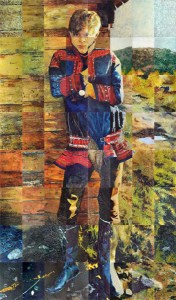
Nils, final full-sized assembled painting. 6‘ 02” x 3‘ 6” or 188 x 107 cm
I took that insight and dove directly into learning about the materials artists have traditionally used to create paintings. I figured then, as I do now, “it ain’t what you paint but the way how you paint it”. Thus, rather than create a number of paintings based on one particular (simple) image but interpreted in different ways (like Josef Alber’ Homage to the Square, Warhol’s soup cans, or Jasper Johns’ American flags), I took one strong central image, cut it into identical parts and rendered each one separately. Each part was intended to function independently as a painting in its own right yet also to contribute to the unity of the whole. That, at least, was the theory, which worked out relatively well at the time (see linked image to the left). Yet of course becoming a master of one’s materials is not an overnight process, it’s much less dependent on a flash of insight than it is upon years of experimentation, dedication, hard work and synchronistic luck (you can’t discount that!). Ultimately that means you guide the materials (and the happy accidents). You do not control them and likewise they do not control you. For in whatever creative process any artist may be involved in, there’s always a symbiosis between the impulse and the materials; there is selection based on discrimination.
Fast forward forty five years and I can now say that I have learned a few things about what makes a painting, any painting, a good painting. One, it’s not about the subject matter in an absolute sense, it never is and never has been, that’s secondary. That’s not to say that the subject matter may inspire the artist. It can and it does, but that doesn’t make it art. What makes it art is the ability of the artist to communicate his or her feeling-experience to you the perceiver in such a way so that you feel it too. Note, the emphasis on two words, “communication” and “feeling”. Which brings us to the second point about what art actually is. I would now say that art, any art (including a good painting) is a felt-intuition succinctly and evocatively expressed/communicated as a sense-based unity. Full stop. Concepts may follow but are entirely secondary. In that sense then, realism and/or abstraction as modes of expression present a false dichotomy.
One possible reason that such a definition has been lacking is that Western philosophy has been slow to recognise that there is a universal dimension to the feeling-intelligence present within all sentient beings. That the subject-based dimension of consciousness can indeed present an aspect of universality, however veiled it may be. It reveals itself daily within the human being as the feeling aspect of consciousness. So, stay tuned for Aesthetics Part I: Gevoelsmatig-Bewustzijn.

 Atelierartisanal's Blog