about Giclée or digital printing
January 29, 2010
With the advent of the digital revolution, the “giclée” or digitally produced ink-jet art print is an upscale and promising venue of digital imaging technology. Images can be easily created, shared and printed the world over. It is clear that inks, paper and techology will consistently improve to offer high resolution, archival prints which can qualitatively equal or even surpass traditional lithography for only a fraction of the cost. As a new medium it promises to be an art in itself, because the tools are back in the hands of the artist.
But as a new medium, it is also important to distinguish a few basic elements of the larger printing world to which it belongs. Printing, be it digital or lithographic, occurs in the world of CMYK, or subtractive light and refers to multiple identical reproductions. It is to be differentiated from the world of painting which usually (but not always) occurs in the world of subtractive light and whose pallette is greatly expanded beyond four basic colors. Additionally, the act of painting refers to a unique product.
What can be confusing for consumers/collectors is the term “limited edition print”. Traditionally this term referred to a run of prints which were created from a means that became dissipated through the action of printing. For example, etching plates whose fine lines grew softer after repeated use. More often, the term “limited edition print” simply referred to the amount of prints generated at any one particular time for economic reasons, not necessarily technical.
In the current world of printing, whether lithographic or digital, the term “limited edition print” refers to economic factors and not physical dissipation, that is the number of copies generated at any one time is determined by how much the artist can spend to produce the images he/she hopes to sell rather than the dissipation of digital pixels (which is absurd) or lithographic plates, which do in fact dissipate in extremely large runs.
In this regard, the Giclée print is directly advantageous to the artist: no huge lithographic print run to manage, pay for and inventory. Artists can now “print on demand” and even sign their work, completely bypassing the “limited edition print” run event, potentially rendering the term altogether meaningless (buyer beware).
Technically, the Giclée print may also be superior to traditional lithography since the ink jets do not require the intervention of tiny lithographic dots to hold the ink. Finer gradations and subtler details can be rendered. For example, the current top range digital printers includes two levels of jets for the cyan and magenta inks (one for the normal range of values and one particularly sensitized to reproduce highlight detail). The archival qualities of the inks are consistently being improved (but still do not retain the longevity of a well executed oil painting) while the substrate is whatever quality technology or ecomomics allow.
The drawback of the Giclée print is the same as it ever was for lithography: CMYK cannot reproduce certain secondary colors, as well as even certain pigments of yellow, red and blue; what is visible on the LED monitor in RGB may not be reproducible in CMYK. Additionally, importantly, and in contrast to painting, a print surface offers extremely little refraction of light through its micro millimetered surface-depth. So the play of light through its surface remains predictably (mechanically) stable, unlike the subtle differences that can be experienced when viewing an original painting. So although the Giclée or digiprint offers many possibilities, a print is still a print…
Painting, Backwards
January 3, 2010
Painting (any painting) always involves pigment mixed into a medium and set upon a ground. The ground is usually white (or possibly even translucent), thus any pigment added to its surface subtracts from its luminosity and is a movement towards darkness. Alternatively stated, light is the source and darkness its covering. Painting reveals light and uses darkness to do so. If the ground is white, then the primal source of light in any painting is its substrate. This being the case, using and manipulating that source of luminosity is of utmost importance. I continually ask myself, is there a way to paint which can maximize the quality of transmissive light in its ground while contrasting it to the reflective quality of opaque pigments? Painting backwards could be one approach. I stumbled upon it by accident. Here’s what happened:
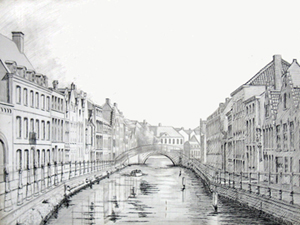
silverpoint with india ink
About a year ago, I began preparing a landscape painting in the usual way. First by gessoing a wooden panel, then by transferring my composition to it using silverpoint. The composition was of the canal in front of my house. I had already created a value study as well as a small oil of the same landscape setting. I was well pleased with both works but felt the composition could benefit from a grander view. So I added buildings to the right and left as well as more sky and water in the foreground. This had the effect of deepening the overall perspective. Nice. Additionally, to enhance the depth from the get go, I highlighted the darker contrasts of the foreground using india ink on top of the already established silverpoint drawing. Nice, again.
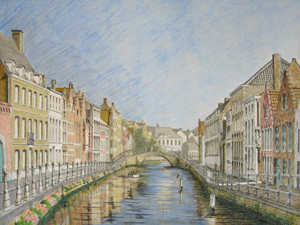
Sint Annarei egg tempera
In order to minimize the number of layers necessary to create an image in oil, I started the underpainting in egg tempera. Rather than mixing a fully saturated color of the chosen pigment for each element in the image, I added white to each color to avoid oversaturated colors in the final painting. (Oversaturated colors can be lethal to the softly diminishing effects of an ephemerally suggested distance: a lesson I had learned the hard way.) So, all the colors were now set up and were rather pastel in character, complimentary color relationships were established, even if at this point they were still rather subtle.
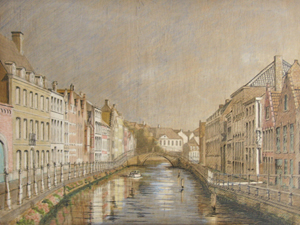
Sint Annarei imprimatura
The next step was unifying all the elements by establishing an overall mood. This is usually done by covering the ground with an imprimatura: a diluted oil color washed over the surface to establish a middle tone. So I painted on a brown imprimatura and then wiped it off. A tonality was established, but it wasn’t quite dark enough. I painted on a second layer of imprimatura just to increase the tonality. But then, rather than painting the highlights back in using white pigment, I decided to erase the imprimatura from the highlight areas using turpentine (I already knew exactly where these areas were as they were well articulated in the underdrawing). This erasing was working well, until I accidentally dipped my brush in distilled water instead of turps. My brush began to delete not only the imprimatura, but also the egg tempera underpainting, the india ink, and then the silverpoint, too. Oops!!! Not what I had intended…

Sint Annarei Final
Amidst my curses and exclamations, it became clear to me that I needed to continue this treatment to balance out the rest of the composition, a work of about 15 minutes. When I was done, my husband took a look at the painting and said, “I think you’re done.” And it was true.
Comments are welcome…

 Atelierartisanal's Blog