More Musings on Memory
July 27, 2009
Two important events occurred in mid-nineteenth century France: Louis Daguerre’s patent application to the French Academy of Sciences for his Daguerreotype and Horace Lecoq de Boisbaudran’s publication of a systematic way for the artist to develop visual memory. The former was destined to radically change the way humans communicate, while the latter would eventually become relegated to the now old fashioned practice of perceiving, conceiving and rendering external reality in terms of three dimensional forms. Additionally, the former could (after the additional technological advancements of more than a century) be used by anyone to communicate anything, while the latter took years of practice to master (by fewer and fewer artists). In Lecoq’s time, one could imagine him to be deeply aware of how the early stirrings of photography might impact both the world – and the artist. But also, the world of his time was still deeply embedded in Western Civilization’s long tradition of the representation of classical forms of beauty. If we fast forward more than one hundred and fifty years, we can see a remarkably different art world functioning now and understand why he has hardly been heard of. Still, back in the day, his methods had a strong influence on Fantin-Latour, Legros, Rodin, Lepère, Lhermitte, George Innes and James MacNeill Whistler, among others.
One additional factor – which also occurred in France around that same time period – could have been nail in Lecoq’s memorial coffin. One year after the 1862 publication of Lecoq’s revised edition of L’Education de la mémoire pittoresque was the famous 1863 Salon des Refusés. Art history books mark this as the beginnings of the Impressionistic movement. It’s readily acknowledged then that the advent of photography provided the impetus for Impressionism and the further deconstruction of the realistic picture space: Neo-Impressionism, Post-Impressionism, Fauvism, Cubism, Surrealism, Da-Da, Expressionism, Pop-Art, Hard-Edge, Color Field, Minimalism, Symbolism, etc… . As they all continued to move away from a form oriented, realistic rendering of external reality they moved towards an abstract vision of an inner, subjective reality. This inner subjective experience of consciousness (on whatever level) then became objectified using whatever tools might be available to the artist – or to which they were attracted. Such expressions then need not have any relation to the external “objective” world rather, if successful, these expressions somehow depicted a universality (that is not subject to the subject-object dichotomy of both science and even language itself). So I wouldn’t argue against any of these developments, as a young artist I was exposed to them all and truly appreciated most. Yet also as an artist I do question what has been lost in the interim. For example, my own artistic education included very little formal training, that is, training in the rendering of form and the use of the traditional materials to do so. So I’ve really had to teach myself.
At this point, and as a very generalised statement of the current artistic world, I humbly submit that by losing touch with the various tools and techniques which artists have used for centuries to render personally significant reactions to the external world in and around themselves, humanity has lost an essential relationship. An essential mirror. I certainly do not argue against abstraction, and conversely, I do not argue for realism. Both languages can be exceptionally powerful or exceptionally vapid, depending upon their practitioner/spokesperson. I’m just arguing for integration. The physical absorbed into the metaphysical; the metaphysical rendered meaningful through the physical. The Heart Sutra of Mahayana Buddhism expresses it this way: Form is Emptiness and Emptiness is Form.
Development of Visual Memory in the Arts
July 23, 2009
In 1848 the art teacher Horace Lecoq de Boisbaudran wrote a treatise called L’Education de la mémoire pittoresque for his students. That treatise was revised and republished in 1862. Later, he wrote two other small texts for his students which were published in 1876 and 1879, respectively. Many notable 19th century artists passed through his atelier: Fantin-Latour, Legros, Rodin, Lepère, Lhermitte among others. Subsequently through Legros, many other artists, like George Innes and James MacNeill Whistler were influenced by his ideas.
Although the mainstream current of twentieth century art has moved away from form inspired realistic interpretations of the world around us, the role of personally significant memory has never been greater. It is with that in mind that I have finally located, downloaded and printed out this text. The translation, which was done approximately one hundred years ago, appears to be a fine one, well researched among the still extant students of LeCoq at that time.
I’m posting this link as information for anyone else who may be interested in exploring Lecoq’s work. The Training of the Memory in Art and the Education of the Artist, Translated by L. D. Luard. Et l’original en français: L’éducation de la mémoire pittoresque, de Horace Lecoq de Boisbaudran. Yesterday, for 14 Euros and an hour of my time, I located the link, downloaded the file, burned a CD, took it to a local print shop, for the which I received a simple, black and white, plastic coated, spiral bound edition. I now have a copy of a book that I have searched twenty years for. Hooray for the internet!!!
After years of experimentation and study, I have come to a technique that at least allows for the possibility of fine painting, in my case landscapes. I’ll try to describe it briefly here below using illustrations from a current project, the Sint Anna Kerk here in Brughes. The value study is completed “en plen air”; the studio work is done in the atelier in successive stages, each oil session is completed “alla prima” (within a few hours). The intent is to capture as much spontneity as possible, within the long time frame that defines an indirect technique.
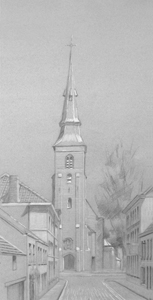 The start is a value study describing mid-afternoon light. It’s usually a simplified version of where I hope to finally go. I consider it invaluable for setting up both the composition and tonality of the final piece. This study here is done with pencil, white chalk and ink on standard charcoal paper. Highlights and shadows are developed to render a simple direct statement. Any addition information needed can be augmented from photographs and direct observation, since I live around the corner, though I try more and more to rely on my own pictorial memory.
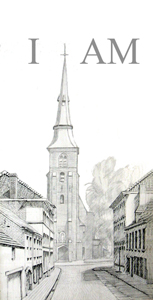 The main elements of the composition are transposed to a panel using line, texture, shading and form. Traditionally, fine drawing pens loaded with india ink are used for transferring the linear, graphical part of the drawing but I have recently been experimenting with using a silverpoint stylus for my underdrawing. The final result is softer, warmer and subtler than india ink (see the grey tones). However, that descriptive subtlety is often lost in the intervening layers of paint, thus, I have begun augmenting the silver point with india ink in order to accentuate the contrasts of the foreground. Thus, distance is described from the beginning in a few ways. The decisions made now guide many aspects of the final result, so it is important to be sure and thus avoid pentimento.
 In order to minimize the amount of oil needed to achieve layers of color, I use a traditional egg tempera technique to begin the painting. Oil can be painted over egg (fat over lean), however egg cannot be painted over oil. In addition, egg tempera must be painted on a hard, firm surface, otherwise it will crack, thus the panel is prepared with a traditional gesso surface.
I use the egg tempera technique to indicate basic broad areas of local color. All objects at this point are better stated as pastel suggestions rather than full strong colors. In this version of the Sint Anna Kerk, I have been careful to keep my colors light in order to avoid an oversaturated painting in the middle and background areas. I have learned (the hard way) that control of hue, saturation and value are critical for describing distance. The vibrations of complimentary colors are hinted at but not yet fully explored. Also, I try to use single pigments only for spectral purity; no color mixing is done on the pallette. Colors (like certain greens and oranges) that might require mixing are indicated through separate layers of translucent paint. This layer will be dry to the touch almost immediately, but it should dry at least one week before attempting to work in oil.
 Although it may seem like a sin to cover the fine egg tempera painting with a blanket of brown, the imprimatura quickly helps to establish the overall key of the piece as well as to unify any disparate elements. The previous egg tempera layer must be not only completely dried but sealed with a layer of glue size to protect it from the succeeding layers of oil based paints. The lines and colors of the previous layers continue to shine through, adding texture and interest, particularly in the mid tones and shadows. The imprimatura is a mixture of damar varnish, turpentine, and brown pigment (in this case, burnt umber). I brush it on, wait a minute or so and then wipe it off with a dry, lint free, soft clean cloth.
Since I was very interested to retain the purity of the whites in the highlight areas of the picture, I went back into the fresh imprimatura with a brush dipped in fresh turpentine to remove the brown tint from the highlight areas. My theory/concept is that even though I will be painting over these areas in white oil paint to create mass and to soften edges, whatever is underneath ultimately does matter. If I want to somehow simulate the intensity of pure light – even if it is reflective and not transmissive – then the purity of the original gessoed board is important. I let the imprimatura then dry a day or so, and begin painting in the Mixed Technique.
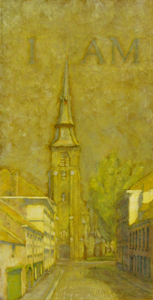 I squeeze a quantity of cadmium yellow onto the pallette and dip a thin, wide bristle brush into the clear medium (1 part Damar, 1 part Stand Oil, 1 part Turps), then scumble in a very thin coat of yellow over the whole surfce. It sets for a minute or so and then I wipe it back off with a soft, lint free cloth. The idea is to leave some translucent color tint with some tack and work the first levels of oil back into it. Because it’s a panel and not canvas, the tackiness of the oil/varnish medium catches the brush stroke well, functioning like the weave of a canvas in attracting the brushstroke yet leaving no trace of a fabric-like texture.
At this stage, I work with two basic colors, yellow and gray. I mix up a gray to match the same value of the pure cadmium yellow medium, in order to set the overall darkest value. I then mix up a series of tints (5 or 6 steps) from both the gray and the yellow to white. I begin painting in large areas trying to quickly cover the whole painting with one of these tints, using a thick bristle brush and an emulsion for the pigments (1 methyl cellulose glue, .5 oil/.5 varnish, 1 water) which hastens the drying time. The drawing and egg tempera levels have already set the stage, so to speak, and function not only as guides but also as mirror like reflections. It takes only a few strokes to bring out a form. I use a fan shaped dry brush to merge forms together.
It’s fine to be working with a limited palette now, thinking ahead by laying in a more saturated yellow for both the greens and the oranges. I use the gray for neutral tonalities, shadow and to suggest distance. The overall contrast is quite low.
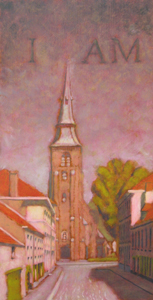 I squeeze a small amount of a cool, translucent red pigment out onto a pallette board. In this case I use crimson lake, in the past I have used alizarin crimson. Dipping a wide, flat bristle brush into clear medium (1T,1D,1SO) and then into the pigment, I proceed to scumble a thin layer of translucent red over the entire piece. After a minute or so, I wipe this off with a clean soft cloth, taking off as much pigmented medium as possible. The remaining surface has a slight tack to the touch.
I mix up three colors this time. Red, in a series of tints up to white. Warm gray mixed in a series of tints up to white and yellow, mixed in the same way. (The value of the pure red is the same value as the pure warm gray, both being close to a pure medium gray value.) Using a big bristle brush and emulsion, I work quickly to re-establish all the values and colors of the intended piece. Occassionally I need to mix a color that requires a combination of two of the premixed tints.
But look, some strong greens are emerging although I haven’t used any green or blue pigment yet! It’s only yellow refracting back through levels of drawing, egg tempera, imprimatura and glaze. Because I use an emulsion (1 methyl cellulose glue, .5 oil/.5 varnish, 1 water) as my painting medium, the work dries quickly, the colors maintain a level of transparency, and the layers of paint are rather lean.
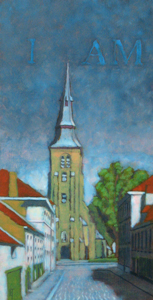 This is the blue level. I premix my intended colors: yellow in a series of 5-6 tints up to white, red, blue and Payne’s gray all mixed in the same way. There are about 20 little blobs of paint, which I may or may not use but I want to be able to work quickly and precisely in my choices.
I squeeze out a small amount of pure cyan (Thalo Blue) and dip my brush in clear medium (1T, 1V, 1 SO). Cyan is a highly saturated pigment with strong tinting power so a little goes a long way. I scumble it on and after a few moments wipe it back off, leaving a slightly tacky surface that has still more blue in it than I would actually prefer. I remind myself to use Ultramarine Blue next time…
I begin to reclaim the highlights and quarter tones, working with a big brush for starters. Any color I paint now picks up a bit of blue from the glaze. Hmmm…that’s good and it unifies the painting, but is there too much blue? A lot of unexpected colors start to happen. OK, let them emerge. I need to reintroduce the main color contrasts, like the orange for the clay tile roof, the brown bricks and the green vegetation. After the main value and hue statements are set, a few details are reintroduced with a smaller brush to help refine those shapes: window and trim, shadows and highlights. After a few hours, I’ve covered the panel. But is it done?
 After the blue session, all the color statements have been made and I’m happy, sort of, but there remains a bluish tint to the whole piece. I could leave it that way, but the intended gray of the church steeple and road pavement encourage me to attempt some gray balance adjustment. So, I cover the entire piece with a clear glaze of medium and wipe it back off (as usual). I mix up a series of tints using Payne’s gray this time as it is both darker and more neutral than the lighter warm gray pigment I have been using. I squeeze out lead white but mix it 50/50 with titanium white; since the painting is moving into it’s oilier stages. I strengthen the pure whites, the gray steeple and pavement, even scumble some body back into the buildings on the shadow side of the street. I put a glaze of yellow on the buildings on the left for local color, and add the final highlights to the tree. There is not much to do, but what is done crisps up value contrasts and defines gray balance.
Eh, voila. C’est fini! The cherries on top are the final touches of gold to the church steeple.

 Atelierartisanal's Blog